

Dubai mortgages in a high-rate environment: what buyers need to know
UAE mortgage rates track the Fed directly. Here is what sustained high borrowing costs mean for Dubai buyers and why off-plan payment plans are gaining ground.
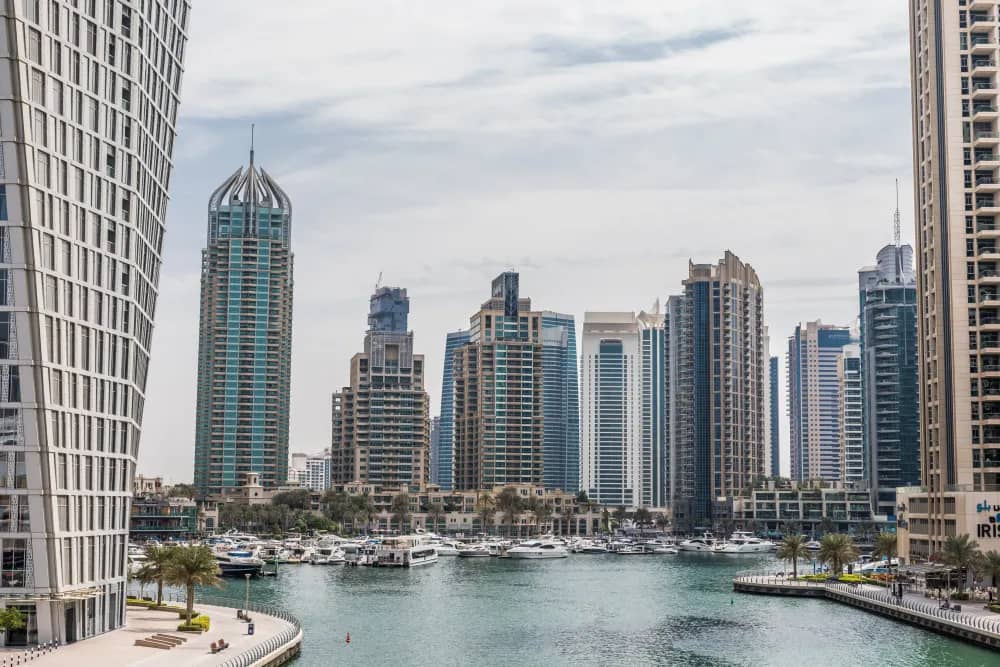
Is now actually a smart time to take a Dubai mortgage?
The question comes up in nearly every buyer consultation right now. The U.S. Federal Reserve has signalled that elevated interest rates are not a short-term anomaly, and because the UAE dirham is pegged to the dollar, the Central Bank of the UAE adjusts its base rate in near-lockstep with Fed decisions. That means anyone financing a purchase in the Dubai property market today is borrowing at rates that were unthinkable just three years ago.
The short answer is: it depends entirely on your financing structure, your hold period, and whether a mortgage is even necessary for your strategy. This piece walks through how UAE mortgage pricing actually works, what the current rate environment costs you in real terms, and why a growing share of buyers in the Dubai real estate market are structuring purchases to avoid bank debt altogether.
How the dirham peg transmits Fed rate decisions
The UAE dirham has been pegged to the U.S. dollar at 3.6725 since 1997. The peg is not ceremonial. It requires the Central Bank of the UAE to shadow Fed rate moves closely to prevent capital arbitrage between the two currencies. When the Fed raised its benchmark rate from near-zero in early 2022 to above 5 percent by mid-2023, the UAE base rate followed. Variable-rate mortgages in the UAE, which are typically priced at EIBOR (Emirates Interbank Offered Rate) plus a bank margin, repriced with each move.
For a buyer who took out a variable-rate AED 2 million mortgage in 2021 at roughly 2.5 percent, the same product today sits closer to 4.5 to 5 percent depending on the lender and the borrower's profile. On a 25-year term, that shift adds approximately AED 3,000 to AED 4,000 per month to the repayment. That is a material change, and it has altered the buy-versus-rent calculation for a meaningful segment of end-users.
What current UAE mortgage rates look like in practice
Most UAE banks offer two mortgage structures: a fixed introductory period, typically one to five years, followed by a variable rate tied to EIBOR; or a purely variable product. As of mid-2025, fixed introductory rates from major lenders are broadly in the 4.2 to 5.0 percent range for salaried expats, with rates for self-employed borrowers or those with shorter UAE employment histories sitting higher. Loan-to-value ratios for expat buyers remain capped at 80 percent for properties under AED 5 million and 70 percent above that threshold, per Central Bank regulation.
The true cost of a mortgage is not only the interest rate. Arrangement fees, property valuation fees, life insurance, and property insurance add roughly 1 to 1.5 percent of the loan value at origination. Buyers reviewing how to buy property in Dubai should factor these in before comparing monthly mortgage costs against rental alternatives.
One practical point: for buyers with strong cash flow and a five-plus year hold horizon, a mortgage is not irrational even at current rates. Dubai gross rental yields in communities like Jumeirah Village Circle and Dubai Silicon Oasis still sit in the 7 to 9 percent range. A leveraged purchase at a 4.5 percent mortgage rate against a 7.5 percent yield produces positive carry before capital appreciation is considered.
Off-plan payment plans as a rate-proof alternative
The sustained rate environment has accelerated a structural shift that was already underway in the off plan Dubai segment. Developer payment plans, where a buyer pays 20 to 40 percent during construction and the remainder on handover or spread over post-handover years, effectively allow a buyer to secure a property at today's price without taking on bank debt until they choose to.
A typical structure from a developer like Emaar Properties or Danube Properties might require a 10 percent booking fee, 30 percent during construction milestones, and 60 percent either on handover or over two to three years after completion. For an investor who intends to sell before or shortly after handover, no mortgage is ever required. For an end-user, the post-handover balance can be financed at whatever rates exist at that future point, with the possibility that rates have moderated by then.
Browse current Dubai off-plan projects to compare payment plan structures across active launches. The terms vary considerably by developer and project stage, so direct comparison is worthwhile before committing to any one scheme.
Communities where the mortgage math still works
Not every market segment is equally sensitive to borrowing costs. The luxury end of the Dubai real estate market, covering areas like Palm Jumeirah and Downtown Dubai, is disproportionately driven by cash buyers, many of them international investors or UAE residents with liquid assets. Rate sensitivity is lower in that tier.
The mid-market, covering apartments in Business Bay, Dubai Marina, and Dubai Creek Harbour, is where financing costs bite most. These are the communities where end-user buyers are most likely to be mortgage-dependent, and where developer payment plans have therefore gained the most traction as an alternative entry mechanism.
Buyers should also note that a property purchased via an off-plan payment plan and subsequently let out can qualify toward UAE Golden Visa through Dubai property eligibility at AED 2 million, though specific conditions around completion status and mortgage encumbrance apply and should be confirmed with a RERA-licensed agent.
What buyers should actually do right now
The mistake to avoid is treating high borrowing costs as a binary signal to pause entirely. The Dubai property market has absorbed significant rate increases while continuing to record transaction volume growth. The DLD recorded over 180,000 transactions in 2024, the highest annual total in the market's history. Demand drivers including population growth, residency visa reforms, and limited secondary supply in certain communities have not disappeared because of the rate cycle.
The practical approach is to determine upfront whether a given purchase requires financing, and if it does, to stress-test the repayment at the current rate plus an additional 50 to 100 basis points. If the numbers work under that scenario, the mortgage risk is manageable. If they don't, an off-plan payment plan structure or a longer savings runway before purchase is the more rational path. A full walkthrough of acquisition costs, from DLD transfer fees to agent commissions, is available in the Dubai properties for sale section of this site.
Frequently asked questions
Do UAE mortgage rates always move with the U.S. Federal Reserve?
Not automatically, but in practice the Central Bank of the UAE adjusts its base rate closely in line with Fed decisions due to the dirham-dollar peg. UAE bank mortgage rates are largely tied to EIBOR, which tracks the UAE base rate, so Federal Reserve moves feed through to borrower costs within weeks.
What loan-to-value ratio can expats get on a Dubai mortgage?
The Central Bank of the UAE caps LTV at 80 percent for expat buyers purchasing properties valued under AED 5 million and at 70 percent for properties above that threshold. UAE nationals receive slightly higher caps. These ratios apply to ready properties; off-plan mortgage rules differ by lender.
Are off-plan payment plans genuinely a way to avoid mortgage rates?
Yes, during the construction phase. A buyer paying in installments directly to a developer is not taking on bank debt and therefore is not exposed to current interest rates. If the buyer plans to finance the remaining balance at handover, they will be subject to whatever rates exist at that point.
What is the typical mortgage rate in Dubai in 2025?
As of mid-2025, fixed introductory rates from major UAE banks are broadly in the 4.2 to 5.0 percent range for salaried expat buyers, with the variable rate kicking in after the fixed period ends. Self-employed applicants and those with shorter UAE employment histories generally receive higher rates.
Can a mortgaged Dubai property still qualify for the UAE Golden Visa?
Potentially yes, but the property must be completed and meet the AED 2 million minimum equity threshold free of encumbrance. A property under mortgage can qualify if the paid-up equity portion meets the threshold. Requirements should be confirmed with a RERA-licensed broker and the relevant authority, as conditions evolve.
More Mortgage posts
 Mortgage
How developer-bank mortgage deals actually save you money in Dubai
Developer-bank mortgage partnerships can cut your borrowing costs by tens of thousands of dirhams. Here is how to read the numbers before you sign.
By Roy El Baba Mortgage
Fixed vs variable mortgage in Dubai's rate-hold environment
The UAE Central Bank held its benchmark rate steady. Here is what that pause means for Dubai buyers choosing between fixed and variable mortgage products right now.
By Roy El Baba