
Dubai's commercial real estate market in 2025: what investors need to know
Office vacancy rates are tightening and Grade A rents are rising. Here is what Dubai's commercial market signals for investors in 2025.
Why commercial real estate is back in focus
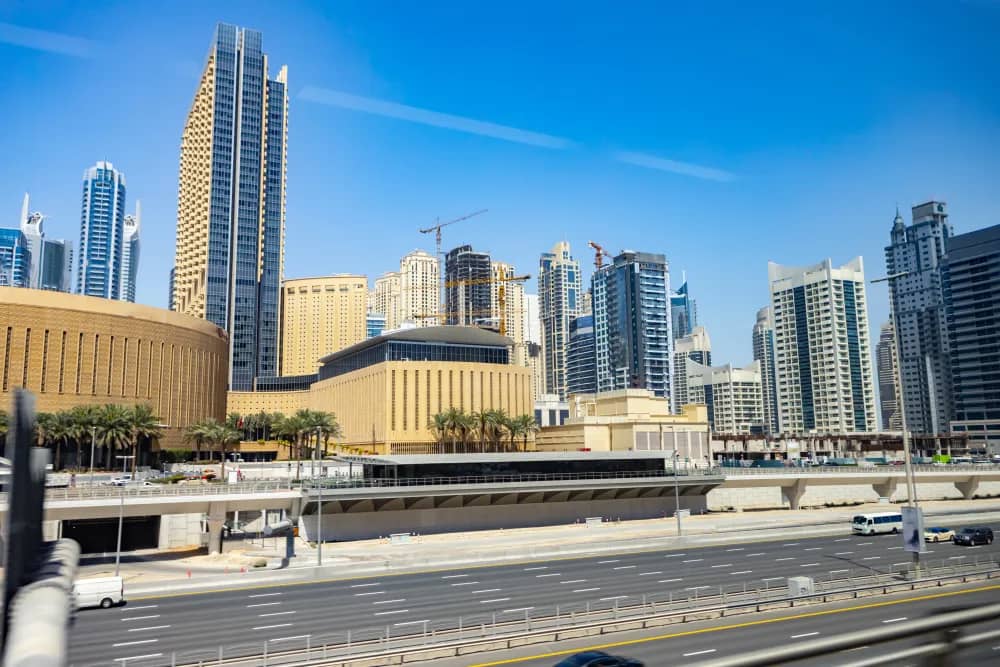
Most coverage of the Dubai property market concentrates on villa price records and off-plan sell-out weekends. That is understandable. Residential transactions generate volume, urgency, and headlines. But investors who track the full picture are paying close attention to a quieter story: Dubai's commercial real estate sector is tightening, and the numbers now justify serious consideration alongside residential allocations.
Grade A office vacancy in central Dubai submarkets fell to single-digit percentages by the end of 2024, according to data from major commercial agencies. Effective rents in premium towers in Business Bay and Jumeirah Lake Towers (JLT) rose between 15 and 25 percent year-on-year in 2024. Those are not speculative projections. They are lease renewal figures that landlords and tenants are negotiating right now.
What vacancy rates and rents are actually telling us
A falling vacancy rate means one straightforward thing: supply is not keeping pace with demand. Dubai's commercial pipeline is constrained in established submarkets. Most new development over the past five years prioritised mixed-use and residential towers over pure commercial stock. That structural undersupply is now creating upward pressure on rents that is unlikely to reverse quickly.
In Business Bay, one of the densest commercial corridors in the emirate, average asking rents for fitted Grade A space crossed AED 180 per square foot in late 2024 for the first time. JLT, which has historically offered a more affordable alternative to DIFC and Downtown, saw rents climb toward AED 120 to 140 per square foot in its better buildings. For investors holding strata commercial units in these zones, capital values have followed rent growth upward.
The DIFC and Downtown clusters remain the most expensive, with some trophy floors transacting above AED 250 per square foot annually. Those benchmarks matter because they anchor the entire market's pricing psychology. When DIFC fills up, tenants cascade into Business Bay and JLT, pulling those rents higher in turn.
Commercial versus residential: the investor calculus
Residential assets in Dubai currently yield between 5 and 7 percent gross in most established communities, with some outliers in emerging areas. Commercial office assets, by contrast, are producing gross yields of 7 to 9 percent in well-located towers with quality tenants on multi-year leases. The yield gap is meaningful, though commercial investing carries its own risk profile: longer vacancy periods between tenants, higher fit-out costs, and a smaller pool of prospective buyers if you want to exit.
The comparison is not simply about yield. Residential investors benefit from a deeper resale market and stronger retail demand, particularly for Dubai properties for sale in communities like Jumeirah Village Circle and Dubai Hills Estate. Commercial assets require a more patient hold strategy and a sharper view on which submarkets will attract the tenant profiles that support premium rents long term.
For investors with a five-year plus horizon and the financial capacity to hold through a potential vacancy cycle, strata offices in established commercial districts represent a genuinely differentiated position in a portfolio that otherwise skews residential.
Key commercial submarkets worth watching in 2025
Jumeirah Lake Towers (JLT) continues to attract financial services firms, logistics companies, and regional headquarters that want proximity to Dubai Marina and Sheikh Zayed Road without DIFC premiums. It is a functioning commercial cluster with a metro link, retail amenities, and an established tenant base. The quality gap between its best and worst buildings is wide, so asset selection within JLT matters considerably.
Business Bay is maturing from a mixed-use experiment into a credible second-tier commercial district. Its proximity to Downtown Dubai and the DIFC corridor means it absorbs overflow demand whenever those markets tighten. Investors should focus on the northern section closest to the water and the Burj Khalifa District, where footfall and tenant quality are strongest.
Dubai Silicon Oasis and Dubai Creek Harbour represent emerging commercial opportunities for investors comfortable with a longer demand curve. Both benefit from government backing and infrastructure investment, but current commercial rents are lower and liquidity is thinner. These suit investors with a development-stage risk appetite rather than those seeking current income.
Structural demand drivers that support the thesis
Three demand drivers have underpinned Dubai's commercial absorption over the past three years. First, the continued relocation of regional headquarters from less stable markets in the MENA region to Dubai, a trend accelerated by geopolitical uncertainty elsewhere. Second, the expansion of financial services and fintech firms attracted by DIFC's regulatory framework and the surrounding commercial ecosystem. Third, the growth of professional services companies serving Dubai's rapidly expanding resident population, which crossed 3.6 million in 2024.
These are structural shifts rather than cyclical bumps. They do not guarantee linear rent growth, but they do suggest that demand for quality commercial space is not a post-pandemic anomaly. Businesses that moved to Dubai in 2020 and 2021 have largely stayed, signed longer leases, and in many cases expanded their footprints. That retention data is as important as new arrival statistics when assessing the durability of commercial demand.
How to approach commercial investment in Dubai
The mechanics of buying commercial property in Dubai differ from residential in a few important ways. Strata office units can be purchased freehold by foreign investors in designated zones, including Business Bay and JLT. The process follows the same DLD registration framework as residential transactions, and how to buy property in Dubai covers the legal and procedural steps that apply to both asset classes.
Service charges on commercial properties tend to run higher than residential equivalents, often between AED 20 and 35 per square foot annually depending on building quality and facilities. Use the service charge calculator to model net yield accurately before committing, since gross yield figures quoted by brokers rarely account for this cost. Financing commercial assets is also more restrictive. Most UAE banks cap commercial mortgage loan-to-value ratios at 50 to 60 percent, compared to 75 to 80 percent for residential, so capital requirements are proportionally higher.
Frequently asked questions
Can foreign investors buy commercial property in Dubai?
Yes. Foreign nationals can purchase strata office units freehold in designated investment zones, including Business Bay, JLT, and DIFC. The transaction process follows the same DLD registration requirements as residential purchases, including a 4 percent transfer fee.
What yields can investors expect from Dubai office assets?
Quality Grade A strata offices in established submarkets are currently generating gross yields of 7 to 9 percent annually. Net yields, after service charges and management costs, typically land in the 5.5 to 7 percent range depending on the specific asset and lease terms.
How does the commercial market in JLT compare to Business Bay?
JLT offers lower entry prices and rents than Business Bay, making it more accessible for smaller investors. Business Bay commands higher rents due to its proximity to DIFC and Downtown Dubai and is better suited to investors targeting larger or higher-value tenants. Asset quality varies significantly within both communities, so building selection is critical.
Is commercial property eligible for the UAE Golden Visa?
The standard UAE Golden Visa property route requires a minimum investment of AED 2 million in a residential property. Commercial real estate does not qualify under the standard residential property pathway. Investors should review the current eligibility criteria, outlined at the UAE Golden Visa through Dubai property guide.
What are the main risks of investing in Dubai commercial real estate?
The primary risks are longer vacancy periods between tenants, higher fit-out and maintenance costs, a thinner resale market compared to residential, and more restrictive financing terms. Investors should model realistic vacancy scenarios and stress-test net yields before committing capital.
More Market Insights posts
 Market Insights
What rising Dubai office rents mean for residential buyers
Dubai office rents climbed 13% while Abu Dhabi occupancy hit 96%. Here is what CBRE's latest data signals for residential buyers in Business Bay and JLT.
By Roy El Baba Market Insights
Dubai property market resilience: what 2025 signals for buyers
Transaction volumes have moderated, but Dubai's residential market fundamentals remain intact. Here's what that means for buyers and investors right now.
By Roy El Baba Market Insights
Dubai office rents rise 13%: what it means for buyers
Dubai office rents climbed 13% year-on-year in Q2 2026. Here is what that means for mixed-use districts and the case for owner-occupier purchases.
By Roy El Baba Market Insights
Dubai property market 2025-2026: should you buy now or wait?
Seven structural demand drivers are keeping Dubai real estate strong through 2026. Here is what each one means for your buying timeline right now.
By Roy El Baba