

What Dubai's end-user shift means for homebuyers
Dubai developers are restructuring projects for buyers who plan to live there. Here is what that means for payment plans, layouts, and your purchase strategy.

Why developers are moving away from flip-focused buyers
For much of the post-2020 boom, Dubai's off-plan market attracted a significant share of buyers who had no intention of ever living in the units they purchased. The strategy was straightforward: reserve a unit at launch price, ride the appreciation curve during construction, and assign or resell before handover. Developers tolerated this because it helped sell out launches quickly and generated headline numbers that fuelled further demand.
That tolerance is narrowing. Several major developers are now openly structuring their projects to make quick resales less attractive while rewarding buyers who commit to occupation. The reasons are partly reputational and partly regulatory. Speculative volumes create price volatility that complicates project financing, disturbs valuations for mortgage applicants, and can undermine community formation in completed developments. Stabilising demand at the buyer end serves developers' long-term interests as much as it serves the market.
How payment plans are being redesigned for occupants
The clearest signal of this shift is in payment plan architecture. Historically, a 20-to-30 percent down payment with the remaining balance on handover was designed to minimise the cash commitment of an investor who planned to exit before that handover date arrived. Some developers are now weighting more of the payment schedule toward the construction phase rather than concentrating it at handover. This structure is less convenient for someone banking on an assignment sale but more manageable for someone planning to actually move in, since the mortgage obligation at handover is smaller.
Post-handover payment plans are also being tied more explicitly to owner-occupier conditions in some projects. Developers including Emaar Properties and Nakheel have, at various points, introduced clauses that restrict early resale or require buyers to retain ownership for a defined period. The practical effect is to filter out buyers whose entire exit strategy depended on flipping the unit in the first twelve months after launch. If you are buying to live in the property, these clauses cost you nothing.
Unit layouts are responding to real occupier needs
Investor-focused projects tend to cluster around studios and one-bedroom units because those deliver the highest price per square foot and the lowest ticket size, two things that matter to someone optimising for yield or resale liquidity. End-user demand looks different. Families and relocating professionals want dedicated study spaces, larger living areas, storage that functions as actual storage, and laundry rooms that are not carved out of the kitchen.
Newer launches in communities such as Dubai Hills Estate, Arabian Ranches 3, and Tilal Al Ghaf have been delivering more three and four-bedroom configurations per project than was typical in the 2014 to 2019 cycle. Maid's rooms, utility rooms, and dedicated parking bays are appearing in layouts that previously omitted them to reduce build cost. These additions raise the ticket price but they also increase the unit's livability, which is precisely what an end-user is paying for.
This does not mean studios and one-beds are disappearing. Projects targeting the Dubai Marina and Jumeirah Lake Towers corridors continue to lead with smaller formats because young professionals genuinely want to live in those locations in that configuration. The shift is more visible in suburban master communities where the majority of buyers intend to raise families.
The concrete advantages for buyers who plan to live in Dubai
If you are purchasing a property you intend to occupy, you are now a preferred customer in a way that was not true five years ago. Developers structuring projects for end-users are more likely to invest in community infrastructure, finishing quality, and post-handover service standards, because their reputation depends on satisfied residents, not on the transaction volume generated during a sales campaign.
From a financial standpoint, genuine homebuyers also benefit from access to mortgage financing that is unavailable to buyers planning an assignment. UAE banks will not lend against off-plan properties until they are near completion, which means a mortgaged purchase is almost definitionally a long-hold strategy. With the Central Bank's loan-to-value cap set at 80 percent for first-time buyers on completed properties, understanding your full acquisition cost upfront is critical. Our Dubai property buying guide covers the full cost breakdown including DLD fees, agency fees, and mortgage registration costs.
End-users also retain access to the UAE Golden Visa through property ownership at the AED 2 million threshold, a benefit that is available regardless of whether you occupy the unit. But if residency and school enrollment for children are part of your plan, that AED 2 million investment doubles as a long-term visa anchor. You can review the residency-by-property route in detail through our UAE Golden Visa guide.
Which communities suit an owner-occupier strategy right now
Location selection looks different when you are buying to live rather than to flip. Proximity to schools, hospitals, supermarkets, and commute routes matters more than proximity to hotel zones or tourist infrastructure. Communities that consistently appear in genuine homebuyer shortlists include Dubai Hills Estate for its school corridor, The Valley for entry-level villa pricing, and Town Square for density of amenities relative to price point.
For buyers prepared to look beyond Dubai, Yas Island in Abu Dhabi offers completed infrastructure, a growing international school base, and pricing that remains below comparable Dubai communities on a per-square-foot basis. The trade-off is a longer commute if your work is Dubai-based, but for remote workers or Abu Dhabi-based professionals it is a legitimate alternative.
Before committing to any community, run the numbers on service charges. A villa at AED 2.5 million in a well-maintained master community can carry service charges of AED 15,000 to AED 25,000 per year. Our service charge calculator lets you model the annual holding cost before you sign anything.
What this means for the broader Dubai market
A market with more end-users is structurally more stable than one dominated by short-cycle investors. Rental yields compress slightly when more buyers occupy their own units rather than releasing them to the rental pool, but capital values tend to be better supported because demand is tied to genuine utility rather than momentum trading.
For buyers considering Dubai off-plan projects today, the practical implication is straightforward: developers are now building communities rather than investment products, and the due diligence process should reflect that. Assess the master plan, the school catchment, the planned retail, and the developer's track record on handover quality, not just the price appreciation potential during construction. That is a different kind of analysis, and it is one that tends to produce better long-term outcomes for buyers who are actually going to live there.
Frequently asked questions
Can I still buy off-plan in Dubai and sell before handover?
Yes, assignment sales remain legal in Dubai subject to the developer's consent and a DLD transfer fee, typically 4 percent of the sale price. However, some developers are now including resale restrictions in their sales and purchase agreements that either prohibit or financially penalise early assignments. Always review the SPA terms before signing.
Are payment plans better now for buyers who intend to occupy the property?
Several developers are structuring payment plans with higher proportions payable during construction and lower balloon payments at handover, which suits buyers planning to take a mortgage at completion. Post-handover payment options are also more common now than they were in the 2015 to 2019 cycle. Terms vary significantly by developer and project, so compare across at least three launches before committing.
Does buying to live in Dubai change my eligibility for the UAE Golden Visa?
No. The UAE Golden Visa property route is based on a minimum property value of AED 2 million and does not require owner-occupation. Whether you live in the unit or rent it out, the visa eligibility threshold is the same. Our Golden Visa guide has the full documentation requirements.
Which Dubai communities offer the best combination of value and liveability for families?
Communities consistently shortlisted by family buyers include Dubai Hills Estate for school access and park infrastructure, The Valley for villa affordability, Town Square for density of amenities, and Arabian Ranches 3 for community maturity. The right choice depends on budget, school preference, and commute requirements.
How do I calculate the total cost of buying a property in Dubai to live in?
The headline price is only part of the cost. Add 4 percent DLD transfer fee, 2 percent agency commission, a DLD registration trustee fee of AED 4,000 to AED 5,000, and mortgage registration of 0.25 percent of the loan amount if you are financing. Annual service charges, which range from AED 8 to AED 30 per square foot depending on the community, are an ongoing holding cost that should be factored into your affordability calculation from day one.
More Market Insights posts
 Market Insights
When global brokerages enter Dubai: what buyers should know
International brokerage brands are entering Dubai's luxury market. Here is what that means for buyers and whether local expertise still wins.
By Roy El Baba Market Insights
Why Gulf tensions push capital into Dubai property
Regional instability historically drives capital toward Dubai real estate. Here is what that pattern means for buyers weighing entry timing right now.
By Roy El Baba Market Insights
What $2.9 billion in one week tells Dubai fence-sitters
Dubai recorded $2.9 billion across 2,931 sales in a single week. Here is what that velocity means if you are still waiting for the right moment.
By Roy El Baba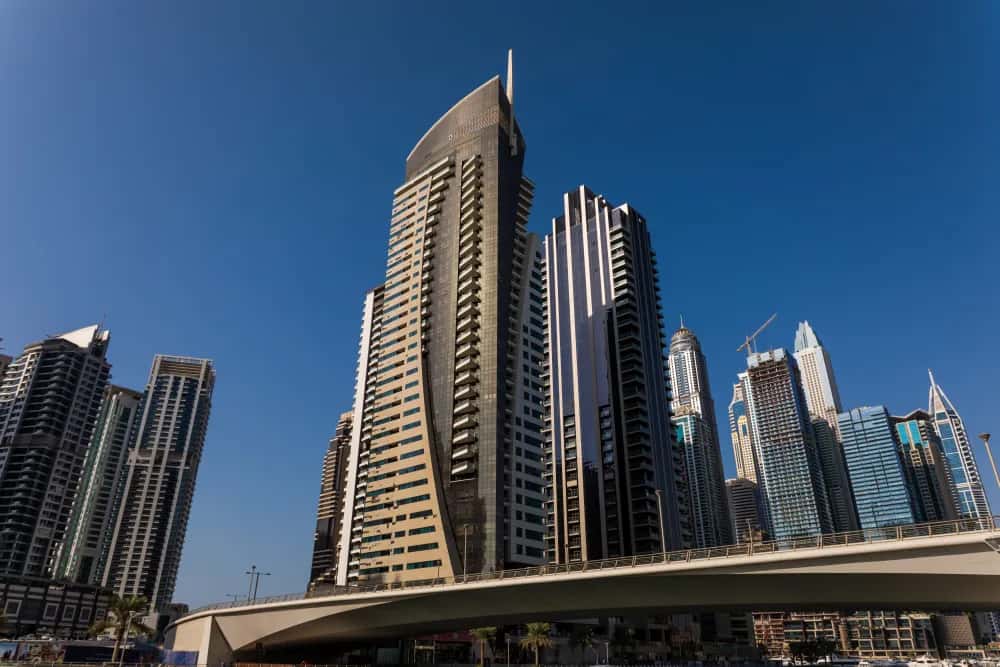 Market Insights
Dubai rentals on track for a record year: what it means for 2027
With 257,000+ contracts logged in eight months and new leases up 19.4%, Dubai's rental market is heading for its strongest year on record. Here is what tenants and investors need to know.
By Roy El Baba