

What a Dh260 million Palm Jumeirah sale tells buyers
A single villa transaction on Palm Jumeirah just hit Dh260 million. Here is what that figure reveals about micro-location pricing across the entire island.
The Dh260 million figure in context
A single residential transaction does not define a market, but it does mark a ceiling. The recent sale of a villa on Palm Jumeirah for Dh260 million is significant not because the number is shocking in isolation, but because of what it confirms about where ultra-prime Dubai villa pricing now sits. For context, Dh260 million converts to roughly USD 70.8 million. That places this transaction firmly within the global top tier, comparable to trophy assets in Monaco, Mayfair, and Malibu.
Dubai's ultra-prime segment, broadly defined as transactions above Dh30 million, has recorded consistent volume since 2022. The Palm has been the dominant address within that bracket. What this latest deal adds is evidence that the top of the market has not pulled back despite higher interest rates globally and some softening in secondary markets. Demand at this level is largely cash-driven and insulated from financing conditions.
How Palm Jumeirah micro-locations are priced
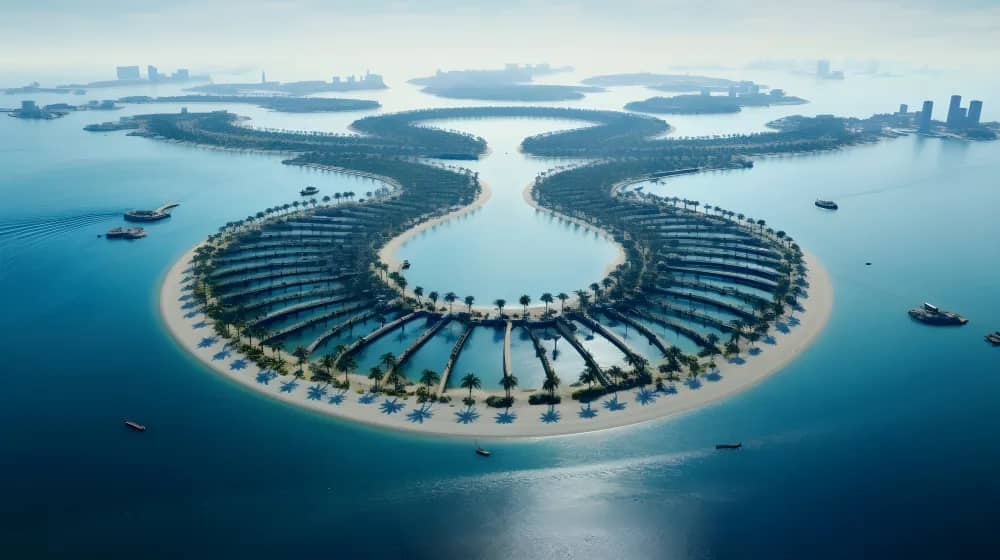
Palm Jumeirah is not a single homogeneous address. It divides into three distinct zones: the Trunk, the Fronds, and The Crescent. Each carries its own pricing logic, and buyers who treat the island as a single market consistently misjudge value.
The Trunk connects the island to the mainland and hosts a mix of mid-rise apartments and townhouses. Entry-level villa equivalents here trade at roughly Dh8 million to Dh18 million for smaller configurations. The Fronds, the 16 palm-shaped extensions radiating from the Trunk, are where most standalone villa supply sits. A standard four- to five-bedroom villa on a shorter Frond with limited sea views trades between Dh18 million and Dh40 million. Longer Fronds with wider plots, direct beach access, and Gulf views on both sides push into the Dh50 million to Dh90 million range. The Crescent, the outer arc of the island, hosts signature hotels and a small number of ultra-exclusive residences. This is where nine-figure transactions originate. The Dh260 million sale falls squarely within Crescent or equivalent end-Frond territory, where plot size, privacy, and unobstructed water exposure combine to produce pricing that has no direct comparable elsewhere in Dubai.
Two variables above all others drive premiums at the top end: plot depth and orientation. A villa on the tip of a Frond facing the open Gulf commands a structural premium over an otherwise identical property mid-Frond facing another villa. Buyers should map these variables before comparing any two asking prices.
What the secondary market data shows
DLD transaction records show that Palm Jumeirah villa volumes in the Dh20 million to Dh60 million bracket have remained robust through 2024, with average per-square-foot pricing on the Fronds rising approximately 18 to 22 percent over a two-year period. That rate of appreciation is slower than the 35 to 40 percent recorded during the 2021 to 2022 surge, which signals a market that is stabilising at elevated levels rather than correcting.
The Dh260 million transaction sits so far above the median that it does not directly compress or expand values mid-market. What it does is validate the asset class internationally. Every time a transaction at this level is reported globally, it reinforces Dubai's position on the shortlist of cities where ultra-high-net-worth individuals allocate residential capital. That reputational effect eventually feeds into mid-market demand as aspirational buyers follow the same geography.
Comparable entry points for serious buyers
Not every buyer is operating at nine figures, but the Palm's pricing structure offers genuine value at lower thresholds once you understand where the premium is actually sourced. A three-bedroom villa on a shorter Frond, purchased today at Dh18 million to Dh22 million, offers a branded Dubai address with direct beach access and a proven resale market. Gross rental yields on these units have ranged between 4.5 and 5.8 percent annually, supported by strong short-term rental demand.
Buyers who want Palm exposure without Frond villa pricing should consider the Shoreline Apartments or Oceana Residences on the Trunk. These offer per-square-foot entry at a fraction of villa pricing while retaining the address and the lifestyle infrastructure. The trade-off is density: these are apartment buildings, not standalone homes, and they do not carry the scarcity premium that drives the headline transactions.
For buyers whose budget sits between Dh5 million and Dh15 million and who want a comparable coastal villa dynamic without the Palm's pricing floor, Emaar Beachfront and Dubai Harbour offer newer inventory with waterfront positioning. These communities lack the Palm's historical brand but offer modern build quality and developer-backed service infrastructure.
The Nakheel factor and future supply
Nakheel, the master developer of Palm Jumeirah, has not released significant new villa supply on the original island since the completion of the Fronds. That supply constraint is structural, not cyclical. The island is built out. Any new ultra-prime product on the Palm comes from existing owners selling, not from new development, which means the supply curve is inelastic against demand shocks.
This dynamic is worth understanding when evaluating price sustainability. In most markets, a spike in prices attracts new supply that eventually cools the market. On Palm Jumeirah, that mechanism is largely absent at the villa level. Palm Jebel Ali is under development and positioned as the next generation of this asset class, but it is at least three to five years from delivering comparable villa inventory at scale. Until then, the original Palm retains a supply advantage that supports current pricing.
What buyers across all budgets should take away
The practical lesson from a Dh260 million transaction is not that only nine-figure buyers should be paying attention. It is that the Palm's micro-location hierarchy is well established and accurately priced by the market. Buyers who understand that hierarchy can identify where value sits relative to the premium being charged. Those who treat the island as a single market will overpay in some sub-zones and miss genuine value in others.
If you are buying for investment, focus on Frond villas with direct beach frontage in the Dh25 million to Dh50 million range. Liquidity at resale is strongest here because the buyer pool is deepest. If you are buying for lifestyle, the Trunk apartment segment offers the address at a fraction of villa cost, with manageable service charges. Run those service charges through a service charge calculator before committing, because annual costs on larger Palm villas can reach Dh200,000 to Dh400,000 depending on plot size and community fees.
For buyers newer to the Dubai market, the buying guide covers the full acquisition process, including DLD fees, agency costs, and ownership structure options. Understanding the total cost of acquisition matters considerably when the asset price runs into the tens of millions.
Frequently asked questions
What is the average price per square foot for a villa on Palm Jumeirah Fronds?
Pricing varies significantly by Frond length and orientation. Shorter Fronds with limited sea views trade at roughly Dh3,500 to Dh5,500 per square foot. Longer Fronds with open Gulf exposure and larger plots can reach Dh8,000 to Dh12,000 per square foot or higher for exceptional plots.
Are Palm Jumeirah villas freehold properties available to foreign buyers?
Yes. Palm Jumeirah is a designated freehold area, meaning non-UAE nationals can purchase villas and apartments with full ownership rights. Buyers may also qualify for a UAE Golden Visa when purchasing property valued at Dh2 million or more.
What are typical annual service charges on a Palm Jumeirah villa?
Service charges depend on plot size and the specific sub-community. A mid-size five-bedroom villa on the Fronds typically incurs annual charges between Dh150,000 and Dh300,000. Larger plots and those on the Crescent carry higher fees. Always verify the exact RERA-registered service charge rate before signing an MOU.
How does Palm Jebel Ali compare to Palm Jumeirah for investment purposes?
Palm Jebel Ali is still in development and offers off-plan pricing that is currently lower than equivalent Palm Jumeirah secondary market values. It carries more development risk and a longer timeline to delivery, but it also offers upside if the community delivers as planned. Palm Jumeirah has an established track record, proven liquidity, and a built-out infrastructure that Palm Jebel Ali does not yet match.
What drove the Dh260 million Palm Jumeirah villa sale price?
Transactions at this level are driven by a combination of plot size, privacy, unobstructed sea views on multiple exposures, architectural quality of the built structure, and the scarcity of comparable inventory. The Palm's fixed supply of top-tier villas means that when a motivated ultra-high-net-worth buyer enters the market, competitive pricing pushes quickly to record levels.
More Market Insights posts
 Market Insights
Dubai hits AED 523bn in 8-month transactions: what it means for Q4
Dubai recorded AED 523.44bn in property transactions across the first eight months of the year. Here is what the deal-type breakdown tells investors about Q4 entry timing.
By Roy El Baba Market Insights
Dubai's $12.6bn August: what the numbers actually tell you
Dubai recorded $12.6bn in total transactions in August, with a single Palm Jumeirah villa selling for $21.5m. Here is what the segment data means for buyers and investors.
By Roy El Baba Market Insights
What $2.9 billion in weekly Dubai deals tells investors
Dubai logged $2.9 billion across 3,098 sales in a single week. Here is what that volume signals about where serious capital is moving right now.
By Roy El Baba Market Insights
What $2.6bn in weekly Dubai sales tells investors
Dubai recorded $2.6 billion across 2,850 transactions in a single week. Here is what that velocity, and a $22M Palm Jumeirah deal, reveals about buyer intent.
By Roy El Baba