Golf City
Dubai community · 0 off-plan projects
About Golf City
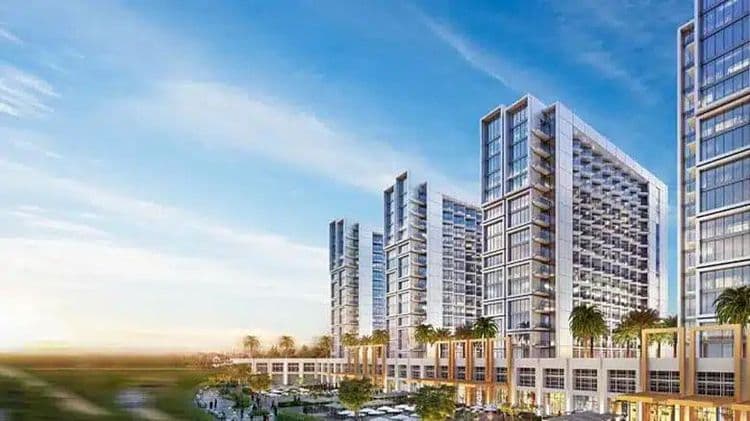
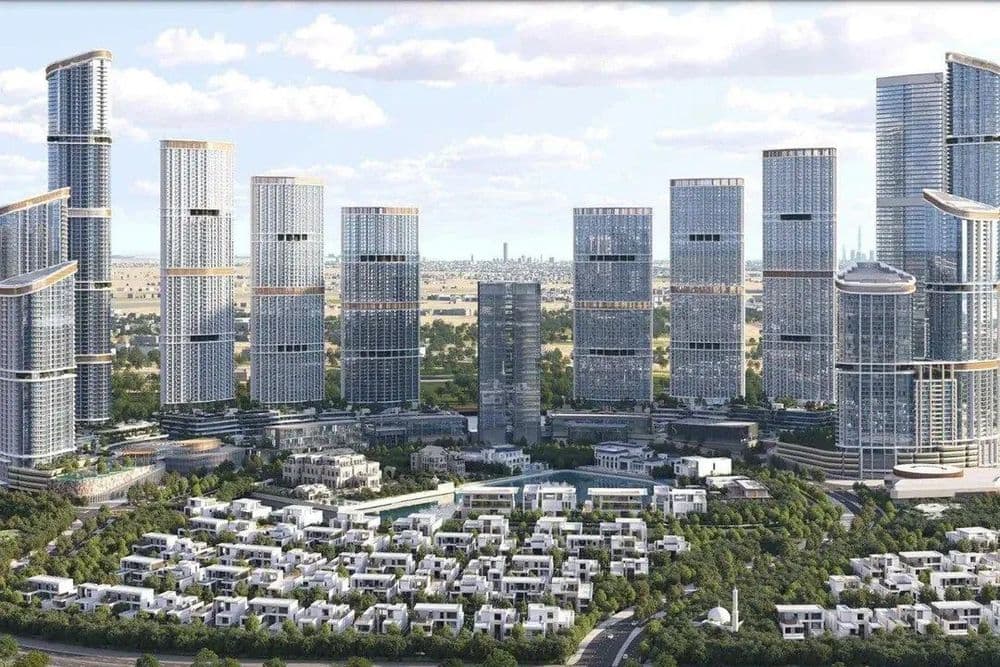
Golf City is one of Dubai's quieter master-planned communities, positioned in the outer growth corridor where land is still affordable and the scale of development feels human rather than overwhelming. Two projects currently sit in our catalogue here — Mykonos Lagoons by DAMAC Properties and Paradise Hills by Gulf Land Property Developers — which tells you something useful: this is still early days. That's not a warning; for the right buyer, it's exactly the point. Our honest read is that Golf City suits patient investors and families who want space, greenery, and a lower entry price than the established mid-belt communities can offer right now.
Market overview
Golf City's supply pipeline is compact by Dubai standards. Our active catalogue carries two projects — Mykonos Lagoons by DAMAC Properties and Paradise Hills by Gulf Land Property Developers — which places this firmly in the early-formation stage rather than the saturated-launch phase you see in, say, Business Bay or JVC. That scarcity of listed product is a double-edged thing: less choice for buyers, but also less downward price pressure from competing inventory.
On pricing, Golf City sits in the affordable-to-mid-market band that characterises Dubai's outer residential corridors. Per-square-foot figures here are meaningfully lower than Dubai Hills Estate or Arabian Ranches, and that gap is the core investment argument. Buyers who missed the early-mover window in those communities are now looking at Golf City with the same logic: get in before the infrastructure catches up with the ambition.
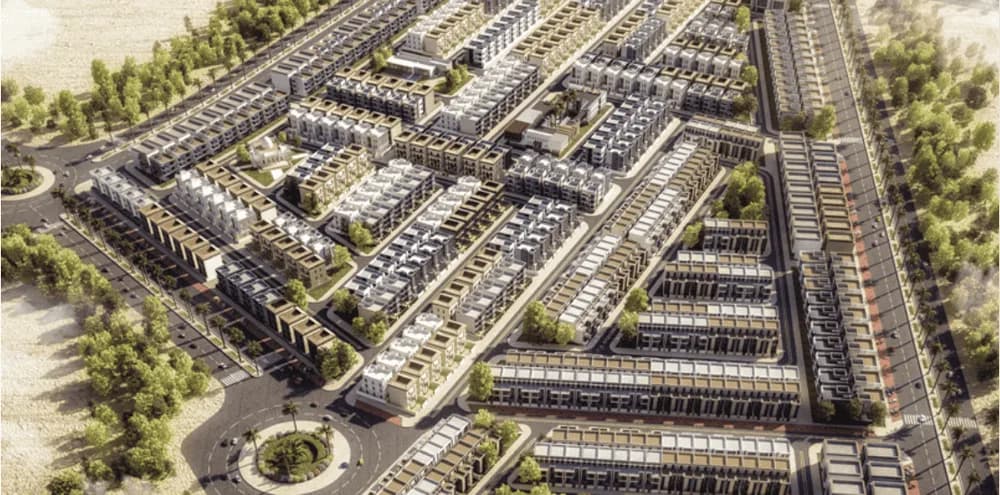
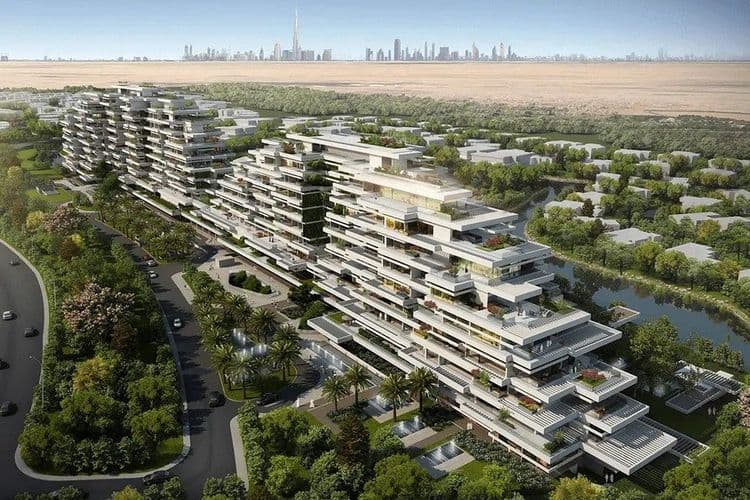
DAMAC's involvement matters. The developer has a long track record of delivering large-scale themed communities across Dubai, and their Mykonos Lagoons branding signals a lagoon-lifestyle product aimed squarely at the aspirational mid-market. Gulf Land Property Developers, meanwhile, brings a different profile with Paradise Hills — a name that leans into the green, elevated-living positioning that resonates with families priced out of premium villa belts.
In our experience, communities at this stage of the cycle tend to see the sharpest capital appreciation between off-plan launch and handover, provided the developer delivers on time and the surrounding infrastructure — roads, retail, schools — moves in parallel. That's the variable to watch here. The projects are in place; the question is how quickly the supporting amenity layer fills in.
Price per square foot in Golf City currently tracks in the lower range relative to established Dubai communities, which means the yield arithmetic can look attractive on paper. Whether that translates into real rental demand depends on occupier confidence in the area's connectivity and day-to-day liveability — both of which are improving but not yet fully proven.
Living in Golf City
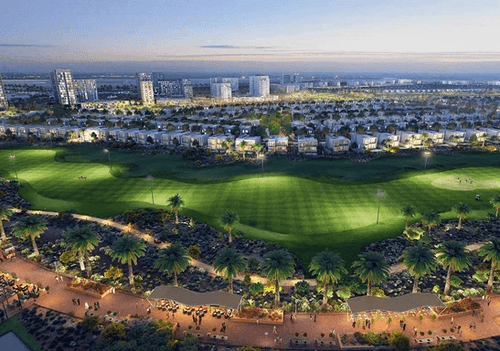
Golf City is unambiguously a family-skewed neighbourhood. The master-plan logic — golf course adjacency, villa and townhouse typologies, lagoon-style amenity — is designed for households that want a garden, a community pool, and a school run that doesn't involve a motorway. Singles and young professionals tend to gravitate toward denser, more connected communities closer to the city core. That's fine; Golf City isn't trying to be JBR.
The vibe is calm. Deliberately so. Residents here are trading the buzz of central Dubai for lower density, more greenery, and the kind of street-level quiet that's genuinely hard to find inside the inner belt. If you've spent time in Arabian Ranches or Mudon, you'll recognise the register immediately — wide internal roads, landscaped buffers, a pace that feels suburban in the best sense.
Our buyers who end up here typically fall into two groups. The first is the growing family relocating from an apartment in a busier community, ready to commit to a villa or townhouse and a longer commute in exchange for space. The second is the investor who's done the maths on entry price versus projected yield and decided the risk-reward is favourable at this stage of the area's development.
Dining and retail within Golf City itself is still developing — that's the honest answer. Residents currently rely on nearby commercial strips and the broader Dubailand corridor for day-to-day needs. This will change as the community matures, but buyers should go in clear-eyed: Golf City today requires a car for almost everything outside the community gates, and the neighbourhood café culture that makes somewhere like Dubai Hills feel complete isn't here yet.
The golf course setting does deliver genuine lifestyle value, though. Morning walks, open sightlines, and a lower built-density than most Dubai communities are real, tangible benefits — not just marketing language.
Schools, healthcare & retail
Golf City's amenity layer is still forming, which is the honest context for everything below. The area benefits from proximity to the broader Dubailand and Al Barsha South catchment, where a reasonable range of established facilities already operate.
Schools within reasonable reach:
- GEMS schools network has multiple campuses across the Dubailand corridor
- Fairgreen International School (Sustainable City) — approximately 10–15 minutes
- South View School, Remraam — within the wider catchment
- Several nurseries and early-years providers in the Al Barsha South / Mudon area
Healthcare:
- Aster Clinic and Mediclinic branches operate across the Dubailand and Arabian Ranches corridor
- For specialist care, Mediclinic City Hospital (Downtown) and Saudi German Hospital are accessible via Emirates Road
- Community-level GP and pharmacy provision is available in nearby retail clusters
Retail & daily needs:
- The Sustainable City's retail strip is within a short drive
- Mudon community retail serves the wider area
- Larger supermarket runs typically involve a 10–15 minute drive to established centres
- Mall of the Emirates and Dubai Hills Mall are both accessible within 25–30 minutes for major retail
The gap in Golf City's current amenity offering is neighbourhood-level retail — the convenience stores, cafés, and pharmacies that make a community feel self-sufficient. That will come as residential occupancy builds, but buyers should plan around it now.
Getting around
Connectivity in Golf City is car-dependent. There's no metro line serving the area, and that's unlikely to change in the near term. Buyers should treat private vehicle ownership as a baseline requirement, not an option.
That said, the road network is functional. Golf City sits within the broader Dubailand corridor, with access via Emirates Road (E611) and Al Qudra Road (D63) providing the main arterial routes. Drive times to key destinations are roughly as follows: Dubai Marina sits around 30–35 minutes in normal traffic; DIFC and Downtown Dubai are approximately 30–40 minutes depending on the route and time of day; Dubai International Airport (DXB) is around 35–45 minutes; Al Maktoum International (DWC) is closer, typically 25–30 minutes, which is a genuine advantage for frequent travellers.
The school run is manageable if you choose a school within the Dubailand or Al Barsha South catchment rather than commuting to the city centre. Several established schools operate within a 10–15 minute drive, which is workable for families.
Our honest assessment: connectivity here is adequate rather than strong. The roads function well outside peak hours, but the absence of public transport and the distance from the metro network means Golf City will always carry a commute premium. For buyers who work from home or have flexible hours, that's a minor inconvenience. For those doing a daily DIFC run at 8am, it's worth factoring in seriously.
Investment outlook
Golf City sits in the mid-market to affordable segment of Dubai's residential spectrum, and that's where the investment case is built. Entry prices are lower than the established villa communities, which means the yield arithmetic can work even at conservative rental assumptions. Mid-market communities in Dubai's outer corridors have historically delivered gross rental yields in the 6–8% range, and Golf City's current pricing suggests it could sit toward the upper end of that band once the community reaches meaningful occupancy.
Capital appreciation is the more interesting story. Dubai's outer growth corridors have a well-documented pattern: early off-plan buyers capture the sharpest gains, values compress as more supply enters, then re-rate upward once infrastructure and amenity catch up with population. Golf City is in the early phase of that cycle. The two projects in our catalogue — Mykonos Lagoons and Paradise Hills — represent the beginning of a supply build-out, not the peak of it.
Resale liquidity is the honest caveat. At this stage, the secondary market in Golf City is thin. Buyers who need to exit quickly may find fewer ready buyers than in a more established community. This is a hold-for-the-medium-term play, not a flip. Investors who bought early in communities like Mudon or DAMAC Hills and held through the infrastructure build-out were rewarded; those who tried to exit before the community reached critical mass often found the process slower than expected.
DAMAC's track record in delivering and then activating communities is relevant here. Their presence in Golf City through Mykonos Lagoons brings developer credibility and marketing reach that smaller operators can't match — both of which support resale values over time.
Our editorial line: bullish, with patience required. Golf City offers a genuine early-mover opportunity in a corridor that Dubai's growth trajectory supports, but investors should plan for a three-to-five year horizon rather than expecting short-cycle returns.
Frequently asked questions about Golf City
Who are the main developers active in Golf City?
The two developers we work with directly are DAMAC Properties (Mykonos Lagoons) and Gulf Land Property Developers (Paradise Hills). DAMAC is the master developer behind the wider DAMAC Hills 2 community, so they control a lot of the infrastructure and amenity rollout. Gulf Land is a smaller but credible developer with a track record of delivering mid-market townhouse communities on time — something our team has verified before listing their projects.
What rental yields can I expect in Golf City?
Based on comparable units in the DAMAC Hills 2 area, we're projecting gross rental yields of 6–7.5% for townhouses once communities reach critical occupancy. Golf City is still maturing, so yields will improve as amenities open and demand from tenants grows. We always advise our investors to factor in a 6–12 month stabilisation period post-handover before expecting full rental income — budget accordingly.
How long is the commute from Golf City to DIFC, Dubai Marina, or DXB Airport?
Expect roughly 35–45 minutes to DIFC, 30–40 minutes to Dubai Marina, and 45–55 minutes to Dubai International Airport under normal traffic conditions via Al Qudra Road and Emirates Road. It's a car-dependent community — there's no metro link yet. Our buyers who work in these hubs typically treat Golf City as a weekend-lifestyle or investment purchase rather than a daily-commute home, which shapes how we position it.
Are there schools and supermarkets near Golf City?
The nearest established schools are in DAMAC Hills (Jebel Ali School, about 15 minutes away) and in Remraam/Mudon (roughly 20 minutes). Within the wider DAMAC Hills 2 community, a retail strip and convenience stores are already operational. A larger community mall is planned but not yet open. We tell buyers with school-age children to factor in the school run — it's manageable but worth planning before you commit.
What makes Mykonos Lagoons different from Paradise Hills in Golf City?
The key difference is the product type and price point. Mykonos Lagoons by DAMAC centres on a crystal lagoon lifestyle — think beach access, water sports, and resort-style pools — and carries a higher price tag. Paradise Hills by Gulf Land offers more traditional townhouse living at a more accessible entry price, starting around AED 1.1M. We help buyers choose based on budget, intended use (investment vs. end-use), and how much they value the lagoon amenity.
Get the Golf City market brief
Live listings, off-plan launches, recent transactions and rental yields — direct from our advisors. No inflated commissions, no spam. One business-day reply.