The World Islands
Dubai community · 0 off-plan projects
About The World Islands
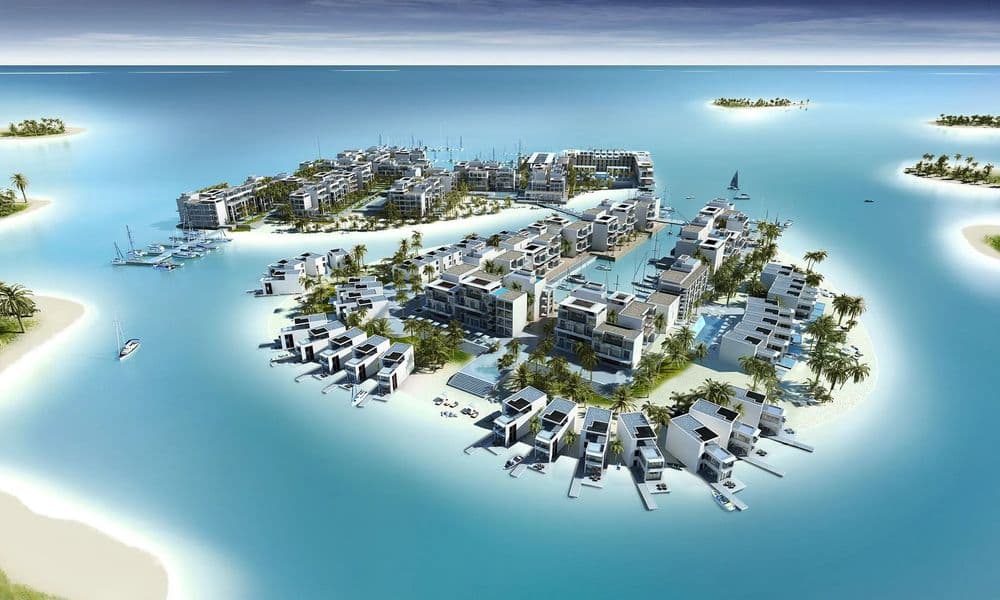
The World Islands is Dubai's most audacious real estate concept — 300 artificial islands arranged in the shape of a world map, sitting roughly 4 kilometres off the Jumeirah coastline. For years it was more spectacle than substance. That's changing fast. With eight active projects in our catalogue spanning branded residences, boutique hotels, and private island villas, the archipelago is finally delivering on a promise that's been two decades in the making. This is not a neighbourhood for everyone. It's for buyers who want genuine scarcity, direct sea access, and the kind of address that simply doesn't exist anywhere else on the planet.
Market overview
Eight projects. That's what we're tracking across The World Islands right now — and the range is striking. You have The Heart of Europe delivering four separate concepts (HYGGE Hotel, InterContinental Hotel, Lido, and The Artist Hotel), MAG Property Development entering with Keturah Bahr, Nami Island Development launching private villas, Zaya with Zuha Island, and Amali Properties with their Amali Island play. The pipeline is deliberately thin by design: the islands themselves are finite, and each developer controls a discrete landmass. Supply can't be manufactured the way it can in JVC or Business Bay.
Price per square foot here operates in a different register to mainland Dubai. Branded residences and private island product in this category typically start well above AED 3,000 per sqft and can push significantly higher for waterfront villa plots with private beach access. The comparison isn't Dubai Hills or even Palm Jumeirah — it's closer to ultra-prime product in Monaco or the Maldives, priced at a fraction of those markets.
In our experience, buyers who enquire about The World Islands fall into two camps. The first are ultra-high-net-worth individuals looking for a primary or secondary residence that is genuinely private — no shared lobby, no shared beach, no shared anything. The second are investors who understand that branded hotel-residences (InterContinental, HYGGE) carry a built-in management and rental programme, which removes the operational headache of owning a remote island property.
The 'Coming Soon' status on several projects — Keturah Bahr, Lido, Nami Island Villas — tells you the pipeline is still building. Early-mover advantage is real here. Buyers who committed to The Heart of Europe's first phases locked in prices that look conservative against current ask levels. That pattern tends to repeat in constrained-supply environments, and The World Islands is as constrained as it gets in Dubai.
One honest caveat: off-plan delivery timelines on island infrastructure projects carry more execution risk than a standard tower. Factor that into your hold horizon.
Living in The World Islands
This is not a neighbourhood in the conventional sense. There are no corner cafés, no school runs, no Saturday morning farmers' markets. What The World Islands offers instead is something far more specific: total separation from the city, surrounded by the Arabian Gulf on every side, with Dubai's skyline visible on the horizon.
The demographic skews heavily towards buyers who already have a primary residence — typically in Emirates Hills, Palm Jumeirah, or overseas — and are adding a retreat property. We don't see many first-home buyers here. The profile is closer to a private island owner than a community resident.
The Heart of Europe's cluster is the most developed in terms of amenity density. Their projects reference a European resort aesthetic — think cobbled plazas, al fresco dining concepts, and climate-controlled outdoor spaces. Zuha Island by Zaya and Amali Island take a more stripped-back, nature-forward approach: fewer people, more water, less programming. Neither is better; they serve different temperaments.
For those who do choose to base themselves here full-time, the practical reality is that every grocery run, school drop-off, and gym session involves a boat or helicopter transfer to the mainland. Some buyers find that liberating. Most treat the islands as a weekend and holiday base rather than a seven-day-a-week home.
Our honest opinion: this is an investor and lifestyle-retreat play, not a family-living neighbourhood. Families with school-age children will find the logistics genuinely difficult. Couples, empty nesters, and investors in branded hospitality product will find it compelling.
Schools, healthcare & retail
The World Islands is intentionally remote, so residents rely on mainland Jumeirah and the broader Dubai coastline for day-to-day amenities.
Schools (mainland, within reasonable transfer distance):
- Jumeirah English Speaking School (JESS) — Jumeirah
- Kings' School Dubai — Al Barsha
- Dubai College — Al Sufouh
- Horizon English School — Jumeirah
Healthcare:
- Mediclinic Jumeirah — one of Dubai's better-regarded private hospital networks, accessible from the Jumeirah embarkation points
- American Hospital Dubai — approximately 30 minutes by car from the mainland marina
- Several GP and specialist clinics along Jumeirah Beach Road
Retail & dining:
- City Walk — roughly 20 minutes from the Jumeirah coastline; strong F&B and retail mix
- Jumeirah Beach Road strip — independent dining, cafés, and boutique retail
- Mall of the Emirates — approximately 25 minutes by car from the mainland access point
- Within the islands themselves, The Heart of Europe's development includes its own dining and hospitality programming, reducing the need for mainland trips during stays
For full-time residents, the mainland dependency is real. For weekend and holiday users, the on-island amenities being developed across the eight projects will cover most short-stay needs comfortably.
Getting around
Connectivity here is water-first, and that's a feature, not a bug — though it does require a mindset shift from mainland Dubai living.
The primary access point is via private boat or water taxi from the Jumeirah coastline, roughly 4 kilometres from shore. Transfer times to the mainland vary by vessel: a fast tender can cover the distance in under 10 minutes; a standard water taxi runs closer to 20–25 minutes. Several island developers include dedicated marina berths and boat transfer services as part of the ownership package.
Helicopter access is available for those who want it, and the proximity to Dubai's general aviation infrastructure makes this practical rather than aspirational.
Once you're on the mainland, drive times are reasonable. The Burj Khalifa and Downtown Dubai are approximately 25–30 minutes by car from the Jumeirah embarkation points. DIFC sits in the same band. Dubai Marina is around 20 minutes. Dubai International Airport (DXB) is roughly 35–40 minutes depending on traffic on Sheikh Zayed Road.
There is no metro connection, and there won't be. That's simply not the product. The World Islands sits outside the urban transit grid by design.
Connectivity is genuinely strong for leisure and hospitality use. For daily commuters, the water transfer adds a layer of friction that most mainland addresses don't carry. Be clear-eyed about that before committing.
Investment outlook
The investment case for The World Islands rests on three pillars: absolute scarcity, branded hospitality income, and Dubai's continued ascent as a global wealth destination.
On scarcity: the islands are fixed in number. No developer can build more. That physical constraint is the single most powerful long-term price support mechanism in Dubai real estate — more durable than master-plan controls or zoning restrictions, which can always be revised.
On yield: branded hotel-residence models (InterContinental, HYGGE) typically target gross yields in the 5–7% range through managed rental programmes, which is broadly in line with prime Dubai product. The trade-off is that you're buying into a hospitality income stream, not a standard residential tenancy. Returns are more variable but carry the upside of strong nightly rates during peak Dubai season (October through April).
Private island villas and standalone residences like Amali Island and Nami Island Villas operate differently. Rental yield is harder to benchmark because comparable transactions are thin. Capital appreciation is the stronger thesis here — these are trophy assets in a category with almost no direct competition in the region.
Resale liquidity is the honest weak point. The buyer pool for a private island villa is narrower than for a one-bedroom in Business Bay. Expect longer hold periods and a more bespoke sales process. This is not a property you flip in 18 months.
In our experience, the investors who do best with ultra-prime, low-liquidity assets are those with a five-to-ten-year horizon and no pressure to exit on a fixed timeline.
Our editorial line: bullish, with patience required. The supply constraint is structural and permanent; Dubai's wealth inflows are accelerating; and the gap between The World Islands' current pricing and comparable island product globally remains wide enough to justify conviction.
Frequently asked questions about The World Islands
Is The World Islands a good investment in 2026?
We genuinely believe so — and the numbers are starting to back that up. After years of slow development, The World Islands has seen a real surge of activity, with developers like MAG, Amali Properties, and The Heart Of Europe all breaking ground or delivering units. Scarcity is the key driver here: there are only 300 islands total, and private residential supply is extremely limited. Our buyers who got in early on projects like Zuha Island and Amali Island are already sitting on strong paper gains.
What is the typical price per sqft on The World Islands?
Pricing varies significantly by island and product type, but expect to pay anywhere from AED 3,500 to AED 8,000+ per sqft for residential villas and branded residences. Hotel-branded units like those within The Heart Of Europe portfolio tend to sit at the higher end. Amali Island and Keturah Bahr by MAG are currently among the most competitively priced entry points for ultra-prime waterfront. We always recommend comparing on a per-key or per-villa basis rather than pure sqft given the bespoke nature of these projects.
Who are the main developers active on The World Islands right now?
We currently carry 8 active projects across the archipelago. The most prolific developer is The Heart Of Europe, behind HYGGE Hotel, InterContinental Hotel, Lido, and The Artist Hotel. On the residential side, Amali Properties is delivering Amali Island, MAG Property Development has Keturah Bahr, Nami Island Development is building Nami Island Villas, and Zaya is behind Zuha Island. Each developer has a distinct positioning — from hospitality-led to pure private residential — so the right fit depends on your goals.
What rental yields can I expect from a World Islands property?
Gross yields on hotel-branded units within The Heart Of Europe projects are projected at 6–8% per annum through managed rental pools, which is attractive for this price bracket. Pure residential villas on private islands like Amali or Nami are less yield-focused — our buyers there are typically purchasing for personal use or capital appreciation rather than income. We always stress-test yield projections with our clients before committing, so reach out and we'll walk you through the actual operator agreements.
How do I get to The World Islands — what's the commute like to DIFC or Dubai Marina?
Access is exclusively by boat or seaplane — there are no road connections to the islands. The Heart Of Europe operates a private ferry service from Marsa Al Arab (Jumeirah), and the crossing takes roughly 10–15 minutes to reach the European cluster. From there, a water taxi to DIFC or Dubai Marina adds another 20–30 minutes by sea, or you can dock at a mainland marina and drive. It's a lifestyle choice as much as a commute, and our buyers who live here typically embrace the separation from the city.
Are there schools and everyday amenities on The World Islands?
There are no schools, supermarkets, or clinics on the islands themselves — this is intentional. The World Islands is designed as a retreat, not a self-contained suburb. Families with school-age children typically use the islands as a weekend or holiday residence, with primary homes on the mainland near schools in Jumeirah or Dubai Hills. For day-to-day needs, residents rely on mainland marinas. Hotel projects like InterContinental and HYGGE do offer F&B, spa, and concierge services on-island.
Can non-UAE residents buy property on The World Islands?
Yes — The World Islands falls within a designated freehold zone, meaning any nationality can purchase and hold 100% ownership. This applies to all the projects in our catalogue, including Amali Island, Zuha Island, and the MAG Keturah Bahr residences. Purchases also qualify for the UAE Golden Visa if the property value meets the AED 2 million threshold, which virtually every unit here does. We handle the full ownership and visa process in-house, so there's no need to juggle multiple advisors.
Get the The World Islands market brief
Live listings, off-plan launches, recent transactions and rental yields — direct from our advisors. No inflated commissions, no spam. One business-day reply.