

Dubai rental yields hit 9.06% in H1 2026: where to buy now
Dubai's average rental yield reached 9.06% in H1 2026. Here's which mid-market communities are beating that benchmark and why they attract buy-to-let investors.

What a 9.06% average yield actually means
Dubai's residential rental yields averaged 9.06% in the first half of 2026, according to data covering the emirate's broader property market. To put that in context, the global average for a mature residential market typically sits between 3% and 5%. London, Singapore and Sydney have spent years hovering in that range. A 9% city-wide average in Dubai is not a statistical blip; it reflects a market where purchase prices have not yet caught up with the pace of rental growth.
For a buy-to-let investor, a city-wide average is a floor, not a ceiling. The most important question is not whether the Dubai property market is performing well overall. It is which specific communities are outperforming that benchmark and why. The answer consistently points to mid-market districts rather than trophy addresses.
JVC and JLT: the two communities that keep outperforming
Jumeirah Village Circle has recorded gross rental yields in the range of 9% to 10.5% across one- and two-bedroom apartments for the past several years. The driver is straightforward: entry prices remain accessible, typically AED 650,000 to AED 1.1 million for a one-bedroom unit, while annual rents for the same unit regularly reach AED 60,000 to AED 85,000 depending on finish and building. JVC Dubai attracts a large tenant pool of professionals and young families who want a quieter residential feel without paying Marina or Downtown premiums.
Jumeirah Lake Towers operates on similar logic. JLT Dubai benefits from Metro access, proximity to DMCC free zone employers and a well-established retail and dining strip at the base of most towers. One-bedroom apartments in JLT have been transacting at AED 700,000 to AED 1.2 million, with annual rents landing around AED 70,000 to AED 95,000. That puts gross yields solidly above the city-wide average for well-chosen units. The key qualifier in JLT is building quality: older stock and newer, better-managed towers show a meaningful gap in achievable rents.
Dubai Silicon Oasis: the overlooked yield play
Dubai Silicon Oasis rarely appears at the top of investor shortlists, which is precisely why it merits attention. Purchase prices here are among the lowest per square foot of any freehold zone in Dubai, with one-bedroom apartments available below AED 500,000 in several buildings. Rental demand is underpinned by the technology and light-industry cluster located within the free zone, creating a captive tenant base of salaried professionals.
Gross yields in Silicon Oasis Dubai frequently exceed 9.5% and in some sub-segments approach 11% for studios and smaller one-bedroom units. The trade-off is lower absolute capital appreciation compared with more liquid markets. An investor prioritising monthly cash flow over short-term price gains will find it hard to find a comparable value proposition elsewhere in the emirate at this price point.
Why trophy addresses lag on yield
It is worth being direct about what the yield data implies for high-profile addresses. Palm Jumeirah, Downtown Dubai and Dubai Marina command premium purchase prices that rental growth has not matched on a percentage basis. Gross yields in these areas typically fall between 4% and 6.5%. That does not make them bad investments. Capital appreciation in these zones has been substantial, and liquidity when selling is higher. But if yield is the primary objective, the numbers do not support paying a location premium.
The same applies to Dubai Hills Estate and Business Bay, both of which attract strong demand but price in that demand at the point of purchase. Investors who bought in these communities three or four years ago are sitting on significant unrealised gains, which changes the yield calculation entirely. For a buyer entering today, the entry price is higher and the yield is correspondingly compressed.
What to check before buying for yield in Dubai
Gross yield figures are a starting point, not a decision. A property purchased at AED 900,000 yielding 9% gross generates AED 81,000 in annual rent on paper. From that, subtract service charges (which in some JVC towers run AED 10,000 to AED 18,000 per year), agent management fees of around 5% to 8% of annual rent, the occasional vacancy gap and maintenance costs. Net yield after those deductions can fall 150 to 250 basis points below the gross figure. Use the service charge calculator to model this accurately for any specific building before committing.
Financing also affects the equation. Dubai mortgage rates for non-residents currently sit between 4.5% and 5.5% on a variable basis. If a buy-to-let is leveraged, the net cash yield after mortgage servicing narrows considerably. Investors using cash get the full benefit of Dubai's above-average gross yield environment. For a complete walkthrough of the purchase process, how to buy property in Dubai covers the DLD transfer fees, agent commissions and registration steps that add roughly 6% to 7% to the purchase price on day one.
Property ownership above AED 2 million also qualifies the buyer for UAE Golden Visa through Dubai property, a 10-year residency benefit that adds a non-financial layer of value for investors considering a longer-term relationship with the emirate.
Positioning your portfolio for the rest of 2026
The H1 2026 yield data confirms what informed investors in the Dubai property market have observed for several years: the best risk-adjusted income returns are concentrated in mid-market freehold communities, not in the headline addresses that dominate international press coverage. JVC, JLT and Silicon Oasis are not emerging or speculative bets. They are established, liquid communities with deep tenant pools and a track record of consistent rental income.
Exploring Dubai properties for sale across these districts will show a range of entry points suited to different portfolio sizes. Equally, understanding the rental landscape before buying is worth the time. Reviewing Dubai rentals for comparable units in any target community gives a realistic sense of achievable rent rather than relying on developer projections or anecdotal figures. The 9.06% benchmark is a strong headline. Building a portfolio that consistently beats it requires choosing the right postcode.
Frequently asked questions
Which Dubai communities have the highest rental yields in 2026?
Mid-market freehold areas consistently outperform the city-wide average. Jumeirah Village Circle, Jumeirah Lake Towers and Dubai Silicon Oasis have recorded gross yields ranging from 9% to 11% depending on unit size and building quality, driven by affordable purchase prices relative to achievable rents.
What is the difference between gross yield and net yield in Dubai?
Gross yield divides annual rent by purchase price. Net yield deducts service charges, management fees, vacancy periods and maintenance before dividing by purchase price. In Dubai, the gap between gross and net is typically 150 to 250 basis points, making it essential to model both figures before buying.
Are rental yields in Dubai sustainable at current levels?
The 9.06% city-wide average reflects a market where rental demand, particularly from an expanding expatriate workforce, continues to outpace the addition of new supply in mid-market segments. Whether yields compress depends on how quickly new off-plan completions enter the market over the next two to three years.
Can a non-resident get a mortgage to buy a buy-to-let property in Dubai?
Yes, several UAE banks offer mortgages to non-resident investors, typically up to 50% loan-to-value. Variable rates currently range from approximately 4.5% to 5.5%. The higher down payment requirement compared to resident borrowers means non-residents need more upfront capital, which affects net cash yield calculations.
Does buying a rental property in Dubai qualify me for a visa?
Property valued at AED 2 million or above qualifies the owner for a 10-year UAE Golden Visa, which includes the right to live in the UAE and sponsor family members. Properties below that threshold may qualify for a shorter-term investor visa depending on the structure of the purchase.
More Investment posts
 Investment
Villa renovation vs buying new in Dubai: which pays off?
Some Dubai villa owners are spending up to $5.4m on renovations. We break down whether upgrading delivers better ROI than buying off-plan or resale.
By Roy El Baba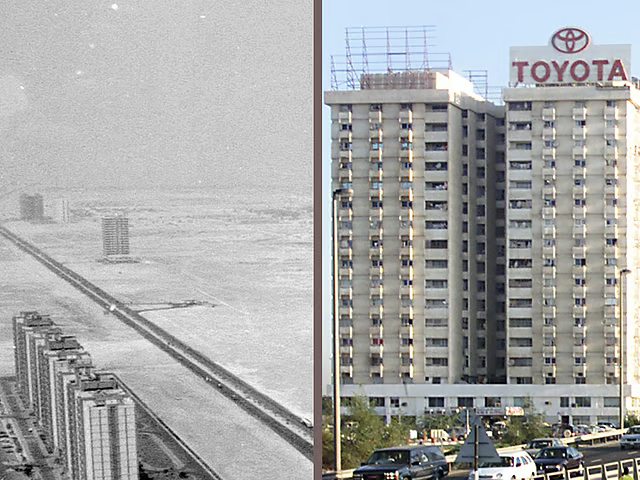 Investment
Sheikh Zayed Road redevelopment: what it means for investors
The Toyota Building's demolition signals a broader redevelopment wave on Sheikh Zayed Road. Here is what plot clearances along prime corridors mean for land values and off-plan launches.
By Roy El Baba Investment
Why Indian investors keep choosing Dubai real estate
Indian nationals are Dubai's largest foreign buyer group. Here's what drives that demand and how NRIs can buy freehold property step by step.
By Roy El Baba Investment
ELLE residences on Dubai Islands: what branded living costs you
ELLE's entry into Dubai real estate signals how fashion brands are reshaping the branded residence market. Here's what the premium actually buys you.
By Roy El Baba