

Golden Visa through Dubai property: a practical guide
The UAE Golden Visa turns Dubai real estate into a residency and wealth-planning tool. Here is exactly how the thresholds, timelines, and holding rules work.

Why the Golden Visa is back in focus
The UAE Golden Visa has been available since 2019, but buyer interest in securing residency through property has surged and dipped in cycles tied to global economic sentiment. After a quieter stretch in late 2024, inquiry volumes have recovered sharply in 2025, driven partly by currency shifts, new investor cohorts from South and Southeast Asia, and a broader re-evaluation of where to anchor long-term wealth. For many buyers currently browsing Dubai properties for sale, residency is no longer an afterthought; it is a core part of the investment thesis.
What separates this cycle from earlier ones is intent. Buyers are asking more precise questions: what property value qualifies, whether mortgage-backed purchases count, how quickly the visa processes, and whether family members are included. That shift in sophistication means generic guidance is no longer enough. The answers matter, and getting them wrong can delay a visa by months or invalidate an otherwise sound purchase.
Property thresholds that qualify for the Golden Visa
The baseline rule is straightforward. A buyer who holds completed property worth AED 2 million or more in Dubai, registered in their name at the Dubai Land Department (DLD), qualifies to apply for a 10-year UAE Golden Visa. The AED 2 million figure is assessed at the time of application and can be satisfied by a single property or a combined portfolio of properties registered under the same owner.
Mortgage-backed purchases do qualify, but with an important condition. The equity paid to date, meaning the amount remitted to the bank or developer rather than the outstanding loan balance, must equal or exceed AED 2 million. In practice, this means a buyer who purchases a AED 3 million apartment with a 50 percent mortgage has AED 1.5 million in paid equity at completion and does not yet qualify. They would need to pay down the loan further or hold an additional asset. Buyers planning to use finance should model this carefully before assuming the visa is automatic at purchase.
Off-plan properties can count toward the threshold, provided the developer is registered with RERA and the purchase is recorded with the DLD under an Oqood (off-plan registration). Some buyers spread their investment across two or three Dubai off-plan projects to reach the AED 2 million mark, which is permissible as long as all units are registered in the same name.
Holding requirements and what happens if you sell
The Golden Visa is tied to property ownership, not to a single transaction. There is no statutory minimum holding period mandating that you keep a specific unit for ten years. However, the visa remains valid only as long as you continue to meet the AED 2 million ownership threshold. If you sell an asset and your remaining portfolio drops below AED 2 million, the visa basis is technically undermined and renewal may be refused.
In practical terms, most holders who sell a qualifying property replace it with another before renewal comes up. The ten-year visa cycle gives considerable flexibility. A buyer who purchased in Downtown Dubai in 2023, for example, could sell in 2027 at a profit and reinvest into a larger unit in Dubai Hills Estate before their 2033 renewal, maintaining continuity without interruption. The key is ensuring there is no gap in qualifying ownership at the point of renewal assessment.
Inheritance and gifting scenarios add complexity. If a property is gifted to a family member, the donor loses the asset from their portfolio for visa purposes. Buyers with estate planning objectives should structure ownership carefully from the outset, ideally with input from a UAE-registered legal advisor.
Family inclusion and practical visa benefits
One of the most compelling aspects of the Golden Visa for property investors is family inclusion. A primary visa holder can sponsor a spouse, children of any age (provided they are unmarried for daughters; sons up to age 25 for standard dependents, with the Golden Visa extending to adult children regardless of marital status in most cases), and domestic staff. This makes the visa genuinely useful for families relocating permanently rather than just investors maintaining a foothold.
From a wealth-planning standpoint, the visa eliminates the need for employer-sponsored residency, which is the most common visa route in the UAE. That independence matters. A buyer who sells a business, exits employment, or simply wants to live between Dubai and another country without an active work contract can do so under the Golden Visa. The residency is not contingent on local income, employment, or a minimum number of days in the country, which distinguishes it from most other residency-by-investment programmes globally.
Banking, schooling, and healthcare access are all tied to residency status in the UAE. Holding a Golden Visa unlocks full access to these services for an entire family unit without the annual renewal cycle that standard employment visas require. For buyers purchasing in family-oriented communities such as Arabian Ranches or Jumeirah Village Circle, this is often the deciding factor.
Where to buy to maximise both yield and visa eligibility
Not every AED 2 million property delivers comparable investment performance. The goal for most buyers is to hold an asset that satisfies the visa threshold while also generating competitive rental yield or capital appreciation. In 2025, several communities offer entry points at or just above AED 2 million with a credible track record on both fronts.
Dubai Marina and Jumeirah Beach Residence (JBR) continue to attract high short-term and mid-term rental demand, with one- and two-bedroom units in the AED 2 to 3 million range delivering gross yields of 6 to 7.5 percent in well-managed buildings. Palm Jumeirah sits at a higher price point but offers stronger capital value resilience. Dubai Creek Harbour is worth watching for buyers who want exposure to a community still in its growth phase, with unit prices that in some cases still sit at or near AED 2 million for a two-bedroom.
Buyers who want a detailed walkthrough of acquisition costs, DLD fees, and agent commission structures should review the how to buy property in Dubai guide before committing. Service charge obligations, which vary significantly by community and building, are another factor worth modelling at the point of purchase using a service charge calculator.
The Dubai property market as a long-term platform
The Golden Visa framing shifts how serious investors should think about the Dubai property market. Rather than asking whether prices will rise 10 percent in the next 18 months, the more relevant question is whether Dubai continues to function as a stable, liquid, and legally transparent platform for holding wealth over a decade or more. On that measure, the case is strong. The regulatory infrastructure, from RERA oversight to mandatory escrow for off-plan developers, has matured considerably since the last major market correction in 2015 to 2016.
The AED 2 million threshold has not changed since the Golden Visa programme launched, and there is no public indication of a revision upward. Buyers who act in the current market are locking in eligibility at today's entry costs. As the dubai property market continues to attract capital from Europe, South Asia, and East Asia, the scarcity of well-located stock at the AED 2 to 3 million mark is likely to compress over time. The Golden Visa is best understood not as a short-term incentive but as the structural architecture around which a multi-year wealth strategy in Dubai can be built.
Frequently asked questions
What is the minimum property value to qualify for a Golden Visa in Dubai?
The minimum is AED 2 million in completed, DLD-registered property. A portfolio of multiple properties can be combined to reach this threshold, as long as all assets are registered under the same owner.
Can I get a Golden Visa if my Dubai property is mortgaged?
Yes, but only the equity portion you have actually paid counts toward the AED 2 million requirement. The outstanding loan balance does not qualify. You need to have remitted at least AED 2 million to the bank or developer before applying.
Do off-plan purchases qualify for the Golden Visa?
Yes, provided the developer is RERA-registered and the purchase is recorded with the DLD via an Oqood registration. The paid portion must meet the AED 2 million threshold; the full purchase price alone is not sufficient.
Does the Golden Visa require me to live in the UAE for a minimum number of days per year?
No. Unlike most standard UAE residence visas, the Golden Visa does not carry a mandatory minimum stay requirement. Holders can travel freely without risking cancellation of their residency status.
What happens to my Golden Visa if I sell my qualifying property?
The visa remains valid until its expiry date, but renewal will require you to again hold AED 2 million or more in qualifying property. If your portfolio drops below the threshold at the point of renewal, the visa basis will not be met. Most holders replace a sold asset with a new purchase before their renewal date.
More Investment posts
 Investment
Villa renovation vs buying new in Dubai: which pays off?
Some Dubai villa owners are spending up to $5.4m on renovations. We break down whether upgrading delivers better ROI than buying off-plan or resale.
By Roy El Baba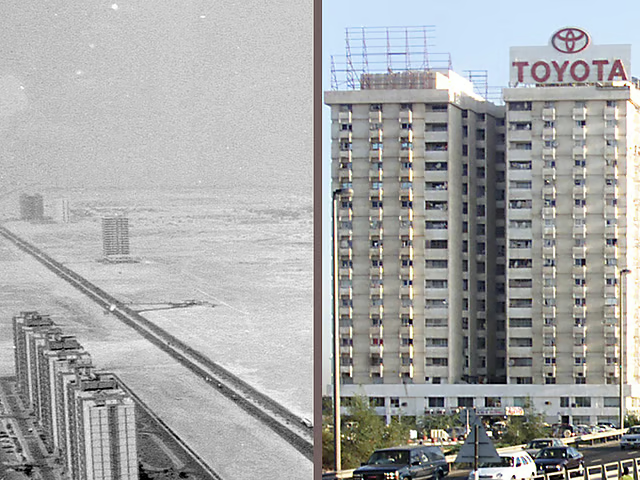 Investment
Sheikh Zayed Road redevelopment: what it means for investors
The Toyota Building's demolition signals a broader redevelopment wave on Sheikh Zayed Road. Here is what plot clearances along prime corridors mean for land values and off-plan launches.
By Roy El Baba Investment
Why Indian investors keep choosing Dubai real estate
Indian nationals are Dubai's largest foreign buyer group. Here's what drives that demand and how NRIs can buy freehold property step by step.
By Roy El Baba Investment
ELLE residences on Dubai Islands: what branded living costs you
ELLE's entry into Dubai real estate signals how fashion brands are reshaping the branded residence market. Here's what the premium actually buys you.
By Roy El Baba