

How infrastructure drives Dubai property price growth
Tracking planned roads, metro lines, and schools tells you more about future returns than any current amenity. Here is how infrastructure has moved prices in Dubai.
Why infrastructure is the clearest price signal
Experienced investors in the Dubai property market do not wait for a community to mature before buying. They track the government's infrastructure pipeline and position themselves ahead of it. The logic is straightforward: every major price re-rating in Dubai's residential history has been preceded by a concrete improvement to connectivity, services, or commercial density, not by marketing campaigns.
The pattern is consistent enough to be predictive. When a new metro station is confirmed, when a major road arterial is funded, or when a flagship school receives planning approval, transactional data typically shows a price response within six to twelve months, often before ground is even broken. Understanding that sequence is the practical edge that separates disciplined buyers from those who pay peak prices after the fact.
Dubai Creek Harbour: a phased infrastructure case study
Dubai Creek Harbour is one of the clearest documented examples of infrastructure-led price appreciation in the current cycle. In 2017, off-plan apartments in the district were trading at roughly AED 1,100 to AED 1,300 per sqft. By late 2023, secondary-market transactions were regularly clearing AED 1,800 to AED 2,200 per sqft for comparable units, representing appreciation in the range of 60 to 80 percent over six years.
The price movement tracks directly with infrastructure delivery. The opening of the Creek Marina promenade, the operational launch of Creek Beach, confirmation of the forthcoming Dubai Creek Tower precinct, and improved road access via Ras Al Khor Road all contributed to a series of upward re-ratings. Each milestone reduced the 'unfinished community' discount that early-stage off-plan buyers had priced in. Investors who bought off-plan Dubai units in 2017 and held through the infrastructure delivery phase captured the bulk of that premium.
The lesson is not simply that Creek Harbour went up. It is that the price curve was not smooth. It accelerated at specific points that corresponded to announced or delivered infrastructure. Buyers who tracked those milestones could time re-entry or exit more precisely than those relying only on headline market sentiment.
Dubai Hills Estate and the school-and-hospital effect
Dubai Hills Estate demonstrates a different but equally instructive dynamic. When Emaar Properties launched the community, early villa buyers in 2016 and 2017 paid between AED 1.4 million and AED 2.2 million for four-bedroom townhouses. By mid-2024, equivalent units were trading at AED 3.8 million to AED 5.5 million in the secondary market.
The critical infrastructure events in Dubai Hills were not transport-related. They were the opening of King's College Hospital Dubai in 2019, the operational phases of Dubai Hills Mall from 2022, and the progressive opening of schools including GEMS and Hartland International campuses within or adjacent to the masterplan. Each of these reduced the family-liveability risk that buyers associate with early-stage communities. When parents can walk or drive under three minutes to a rated school and a private hospital is ten minutes away, the addressable buyer pool expands sharply and prices respond accordingly.
For investors evaluating Dubai real estate today, the takeaway is to map planned healthcare and education infrastructure against communities that are still in mid-development. The price correction that comes with full-service delivery is entirely repeatable.
JVC Dubai: metro proximity and the long game
Jumeirah Village Circle has spent most of its existence priced at a discount relative to better-connected communities. At AED 800 to AED 1,100 per sqft for apartments through much of 2021 and 2022, JVC Dubai attracted yield-focused investors who accepted the trade-off of limited public transport in exchange for strong gross rental returns, typically 7 to 9 percent.
The long-term price thesis for JVC changed materially when the Dubai Metro Blue Line was formally confirmed in 2023, with a proposed station serving the district. Price-per-sqft for apartments near the anticipated station corridor moved upward by an estimated 15 to 22 percent within twelve months of the announcement, according to DLD-registered transaction data. That re-pricing happened before a single metre of track was laid. Investors who understood the infrastructure calendar in advance captured the announcement premium. Those who bought after the news broke paid a higher entry point, though the delivery premium is still ahead.
This is a recurring pattern across Dubai. Metro station confirmations for areas like Al Furjan and Dubai Silicon Oasis have historically generated immediate price responses. The Blue Line extension makes this dynamic relevant to a new cluster of mid-market communities over the next five to seven years.
What to look for before you commit capital
The practical framework for infrastructure-led investment starts with the Roads and Transport Authority's published project pipeline, the Dubai Urban Master Plan 2040 land-use maps, and KHDA school approval data. Cross-referencing these against communities still trading at mid-development pricing identifies where the next infrastructure-to-price linkage is likely to occur.
Beyond transport, watch for commercial anchor tenants. The arrival of a Grade A office campus, a large-format retail operator, or a branded hotel within a residential community consistently compresses the liveability discount. Business Bay transitioned from a largely weekend-empty office district to a residential destination partly because F&B and retail density reached a critical mass. The sequence matters. Residential prices follow commercial activation, not the other way around.
Before finalising any purchase, review service charges against projected community completion timelines, as partially built communities often carry higher per-sqft charges relative to delivered amenity. The service charge calculator is a useful starting point for that comparison. For a full walkthrough of the buying process, see our guide to buying property in Dubai.
Off-plan entry and infrastructure timing
Buying off-plan in Dubai during the early phase of a community's infrastructure buildout is historically where the largest returns have been generated, but it carries the highest execution risk. The bet is that announced infrastructure will be delivered on or near schedule and that the developer, such as Emaar Properties or Nakheel, has the balance sheet and regulatory clearances to complete the masterplan.
A practical risk-reduction approach is to require at least one major infrastructure milestone to already be delivered or under active construction before committing capital. Buying after ground breaks on a metro station, hospital, or school reduces the planning-risk premium while still leaving meaningful upside from delivery and population absorption. Investors qualifying under the UAE Golden Visa through Dubai property program at the AED 2 million threshold often find that off-plan units in Phase 2 or Phase 3 of established masterplans offer the best balance of entry price, title security, and infrastructure certainty.
Frequently asked questions
Which type of infrastructure has the biggest impact on Dubai property prices?
Metro station confirmations tend to generate the fastest price response, often within months of the announcement. However, the largest sustained appreciation typically comes from a combination of transport, healthcare, and education infrastructure delivering together, as seen in Dubai Hills Estate between 2019 and 2024.
Is it better to buy before or after infrastructure is confirmed?
Buying before confirmation carries planning risk but offers the highest potential upside. Buying after confirmation but before delivery captures a meaningful premium with lower execution risk. Buying after full delivery means paying the completed community price, which reduces return potential but also reduces risk.
How does the Dubai Metro Blue Line affect current investment decisions?
The confirmed Blue Line extension, including stations near JVC and several mid-market districts, has already driven initial price responses in those corridors. Investors willing to hold for five to seven years through the construction and operational phases have historically seen strong returns from comparable metro-adjacent plays.
Does off-plan property in Dubai benefit more from infrastructure than ready property?
Off-plan buyers in pre-infrastructure communities can capture both the construction appreciation and the infrastructure premium, giving them two compounding return drivers. Ready property buyers in the same community typically capture only the ongoing infrastructure premium from that point forward.
How can I research planned infrastructure for a specific Dubai community?
The RTA's published project register and the Dubai Urban Master Plan 2040 documents are the primary public sources. KHDA's school approval pipeline is useful for education infrastructure. Cross-referencing these with DLD transaction data for specific plot numbers gives a reliable picture of where price-per-sqft movements are beginning.
More Investment posts
 Investment
Villa renovation vs buying new in Dubai: which pays off?
Some Dubai villa owners are spending up to $5.4m on renovations. We break down whether upgrading delivers better ROI than buying off-plan or resale.
By Roy El Baba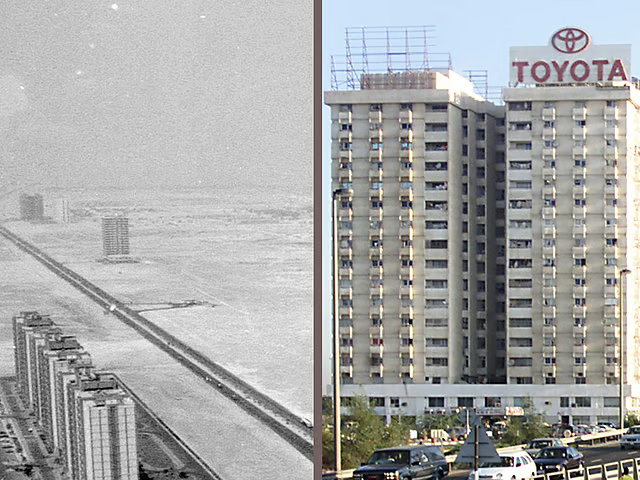 Investment
Sheikh Zayed Road redevelopment: what it means for investors
The Toyota Building's demolition signals a broader redevelopment wave on Sheikh Zayed Road. Here is what plot clearances along prime corridors mean for land values and off-plan launches.
By Roy El Baba Investment
Why Indian investors keep choosing Dubai real estate
Indian nationals are Dubai's largest foreign buyer group. Here's what drives that demand and how NRIs can buy freehold property step by step.
By Roy El Baba Investment
ELLE residences on Dubai Islands: what branded living costs you
ELLE's entry into Dubai real estate signals how fashion brands are reshaping the branded residence market. Here's what the premium actually buys you.
By Roy El Baba