

Is a tokenised Dubai property legally secure?
Every investor asks the same question before buying a tokenised asset: is it as legally binding as a traditional title deed? Here is what the DLD registry link actually means.

The question investors are actually asking
Tokenised real estate has generated significant coverage in the Dubai property market over the past two years, but most of that coverage explains the concept rather than addressing the concern that matters most to a serious investor. The concept is straightforward enough: a physical asset is divided into digital tokens, each representing a fractional ownership stake. The real question is whether those tokens carry the same legal weight as a conventional title deed registered with the Dubai Land Department (DLD).
The short answer is: they can, provided the tokenisation platform is integrated directly with the DLD's official land registry. That distinction separates a legally recognised ownership record from a private blockchain entry that has no standing under UAE property law. Understanding that difference is the first thing any buyer should verify before committing capital to a tokenised asset.
How the DLD registry link actually works
The DLD launched its real estate tokenisation pilot in late 2024, positioning Dubai as one of the first jurisdictions to anchor digital property tokens to a sovereign land registry rather than relying solely on private smart contracts. Under this framework, when a property is tokenised through an approved platform, the token issuance is recorded at the DLD level. Each token maps to a title deed entry, not to a corporate share structure or a trust arrangement. Ownership is therefore traceable through the same registry that governs every conventional sale in the emirate.
This matters because title deed registration in Dubai is the legal event that establishes ownership. A token backed by that registration inherits its legal standing. A token issued by a platform that simply holds the deed in a special purpose vehicle (SPV) while selling tokens against corporate equity does not offer the same protection; in a dispute, you would be a shareholder in the SPV, not a property owner under UAE law. Before you invest, ask the platform directly: is my ownership recorded at the DLD, or am I holding equity in a corporate structure?
What fractional ownership means for your rights
Fractional ownership through DLD-linked tokenisation gives investors proportional rights to rental income and capital appreciation, similar to co-ownership under conventional UAE property law. Investors can also potentially use their token holdings as collateral, though mortgage products tied to fractional tokens are still in early development in the Dubai real estate ecosystem.
One practical consideration: exit liquidity. A traditional property title in a community like Downtown Dubai or Dubai Marina can be sold on the open market through any RERA-licensed broker. Tokenised fractions depend on secondary marketplace liquidity, which varies significantly by platform and by asset. Investors who prioritise exit flexibility should weigh this carefully before allocating capital to a tokenised product over a direct purchase.
Where tokenisation fits in a Dubai investment strategy
Tokenisation is not replacing conventional property ownership in Dubai; it is opening the market to a segment that was previously priced out of direct investment. A one-bedroom apartment in Business Bay trades at roughly AED 1.2 million to AED 1.8 million at present. A tokenised fractional stake in the same asset type can be accessed at a fraction of that entry point, allowing investors to build exposure to the Dubai property market without the full capital commitment or the transactional overhead of a direct purchase.
For investors already considering direct purchases, the off-plan Dubai segment continues to attract significant capital, with developers offering phased payment plans that achieve a similar capital efficiency to fractional ownership. The key difference is that an off-plan purchase still results in a single freehold title in your name upon completion, whereas tokenisation retains the fractional structure throughout the holding period. Both routes are covered in detail in our guide to buying property in Dubai.
Investors targeting longer-term residency benefits should also note that tokenised fractional holdings are unlikely to meet the AED 2 million property value threshold required for the UAE Golden Visa through Dubai property, since each individual token represents only a fraction of the total asset value. A direct purchase remains the cleaner route if residency is part of the objective.
Due diligence checklist before buying a tokenised property
Regardless of how a platform markets its product, the due diligence process should include five non-negotiable checks. First, confirm the platform holds a RERA or DIFC licence and is approved under the DLD tokenisation programme. Second, verify that ownership is recorded at the DLD registry, not simply held within an SPV. Third, read the token terms to understand voting rights, decision-making on property management, and the process for a property sale. Fourth, assess secondary market liquidity: how many buyers and sellers are active on the platform, and what is the average time to exit a position? Fifth, understand the fee structure, including platform fees, property management charges, and any transfer costs on exit.
Platforms that are reluctant to answer these questions directly, or that bury the SPV structure in footnotes, warrant significant caution. The DLD's registry integration is a genuine advancement for the Dubai property market, but it only protects investors who are buying through compliant, registered channels. Checking the Dubai properties for sale market for comparable direct-ownership assets is always a useful benchmark before committing to a tokenised product.
The broader signal for Dubai real estate
Dubai's decision to integrate tokenisation with its official land registry rather than leaving it to private platforms is a meaningful signal about the emirate's regulatory approach. It follows the same philosophy seen in other areas of the Dubai real estate framework: establish clear rules early, licence the participants, and create accountability through the DLD rather than around it. That approach has historically been what differentiates Dubai from other emerging property markets that attract capital but struggle to retain investor confidence.
The tokenisation programme is still early stage, and the secondary market infrastructure that would make fractional tokens as liquid as listed equities does not yet exist at scale. But the legal foundation is now in place. For international investors who want fractional or digital exposure to one of the world's most active real estate markets, the DLD registry link is the single most important feature to verify. Communities like Dubai Creek Harbour and Dubai Hills Estate are among the asset types likely to appear in early tokenisation offerings given their appeal to institutional and international buyers.
Frequently asked questions
Is a tokenised property in Dubai legally the same as owning a title deed?
It depends on the platform. If the token is linked directly to a DLD-registered title deed, it carries legal standing under UAE property law. If ownership is held in a corporate SPV and you hold equity in that company rather than a DLD record, the legal position is materially different. Always confirm which structure applies before investing.
What is the minimum investment for a tokenised Dubai property?
Minimum entry points vary by platform and asset, but tokenisation is specifically designed to lower the capital threshold below the AED 1 million-plus range typical of direct purchases. Some platforms allow fractional stakes from AED 2,000 to AED 10,000, though liquidity and returns are proportional to the fraction held.
Can I use a tokenised property holding to qualify for the UAE Golden Visa?
Fractional token holdings are unlikely to qualify because the Golden Visa property route requires an individual to own property with a minimum value of AED 2 million. A fractional stake represents only a portion of the asset value. A direct freehold purchase remains the standard route for visa eligibility.
Which Dubai communities are most likely to feature in tokenised property offerings?
High-demand communities with strong rental yields and international investor interest tend to attract tokenisation first. Areas like Downtown Dubai, Dubai Marina, Business Bay, and newer master-planned communities such as Dubai Creek Harbour and Dubai Hills Estate are among the most likely candidates given their liquidity and track record.
How do I verify that a tokenisation platform is approved by the DLD?
The DLD publishes its approved operator list and you can cross-check any platform's licence status through the Dubai REST app or the DLD's official portal. You can also verify the platform's RERA licence number through the Real Estate Regulatory Agency's online registry. Do not rely solely on a platform's own claims.
More Investment posts
 Investment
Villa renovation vs buying new in Dubai: which pays off?
Some Dubai villa owners are spending up to $5.4m on renovations. We break down whether upgrading delivers better ROI than buying off-plan or resale.
By Roy El Baba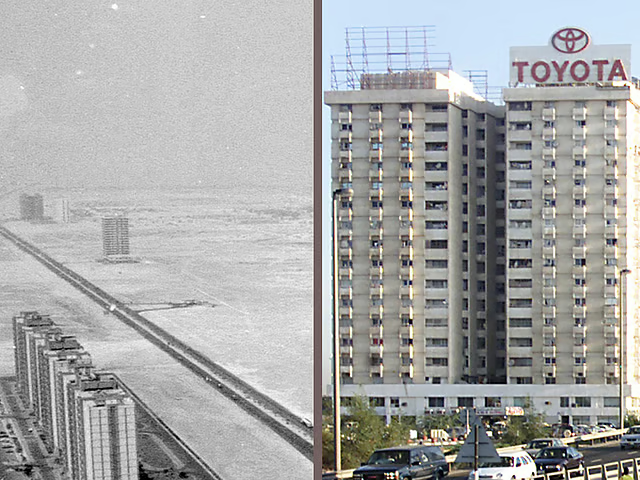 Investment
Sheikh Zayed Road redevelopment: what it means for investors
The Toyota Building's demolition signals a broader redevelopment wave on Sheikh Zayed Road. Here is what plot clearances along prime corridors mean for land values and off-plan launches.
By Roy El Baba Investment
Why Indian investors keep choosing Dubai real estate
Indian nationals are Dubai's largest foreign buyer group. Here's what drives that demand and how NRIs can buy freehold property step by step.
By Roy El Baba Investment
ELLE residences on Dubai Islands: what branded living costs you
ELLE's entry into Dubai real estate signals how fashion brands are reshaping the branded residence market. Here's what the premium actually buys you.
By Roy El Baba