

Beyond Emaar: the case for developer diversification in Dubai
Emaar's dominance is real, but Dubai's off-plan market now runs on a dozen credible developers. Here is why that depth protects investors in 2025.
Why developer concentration risk matters for buyers
When a single developer captures a disproportionate share of any real estate market, buyers face a structural vulnerability that rarely gets discussed during the sales process. If that developer slows launches, adjusts payment terms, or hits a delivery backlog, the supply pipeline tightens and prices in dependent communities can swing sharply. In Dubai's case, Emaar Properties has long held the top position by sales volume, and for good reason. Its track record on delivery, the pull of addresses like Downtown Dubai and Dubai Creek Harbour, and its marketing machine are genuine advantages. But a market that leans entirely on one player is, by definition, a fragile one.
The good news is that the Dubai property market in 2025 no longer fits that description. DLD transaction data and project pipeline disclosures show that at least eight to ten developers are now operating at a scale that would have been considered mid-tier only five years ago. That breadth changes the risk profile for off-plan buyers considerably, and it is a structural shift that deserves more attention than it typically receives.
Emaar Dubai: still the benchmark, not the only option
Emaar's numbers remain formidable. Its communities across Dubai Hills Estate and the Downtown corridor continue to set the price benchmarks that the rest of the market references. For investors focused on liquidity, Emaar-branded units generally resell and re-let faster than comparable product from lesser-known developers, a practical advantage that justifies the premium in many cases.
That said, premium pricing is the trade-off. Entry costs in Emaar's flagship communities have moved sharply since 2021. A one-bedroom apartment in a new Emaar launch in Dubai Creek Harbour or Dubai Hills now regularly opens above AED 1.5 million, with post-handover appreciation already partially priced in. Investors chasing yield rather than capital preservation need to look further down the developer list, and that is precisely where the market's new depth becomes relevant.
Which developers are building credible track records
Sobha Realty has completed multiple phases of Sobha Hartland and is now launching Sobha Seahaven at Dubai Marina, consistently hitting construction milestones that have converted sceptics. DAMAC Properties has delivered over 40,000 units since its founding and its DAMAC Hills community now has a functioning resale market, a signal of genuine end-user demand rather than speculative churn. Aldar Properties, while Abu Dhabi-headquartered, has expanded into Dubai with structured payment plans and an institutional balance sheet that reduces delivery risk. Danube Properties has built its model around sub-AED 1 million entry points across several completed projects in Al Furjan and Jumeirah Village Circle, giving first-time investors a foothold the premium brands do not offer.
None of these developers match Emaar's brand equity, and investors should not expect them to. What they do offer is a combination of demonstrated delivery history, diversified community profiles, and price points that Emaar has effectively vacated as it moves further upmarket. For a buyer building a portfolio of Dubai off-plan projects, spreading across two or three of these names reduces single-developer exposure without sacrificing quality.
What diversification actually looks like in a Dubai portfolio
Practical diversification in the Dubai off-plan space is not simply about buying from different developers. It involves matching developer profile to investment thesis. If the goal is capital appreciation on a three to five-year horizon, a developer with a large, master-planned community still mid-cycle, such as Sobha's Hartland II or Aldar's Dubai expansion, offers more upside room than a fully matured Emaar address. If the goal is rental yield from day one of handover, smaller developers with completed stock in high-density rental corridors like Business Bay or Jumeirah Lake Towers (JLT) can outperform on a net-yield basis.
The financial mechanics also differ. Some developers offer post-handover payment plans extending 24 to 36 months beyond completion, which changes the effective cost of capital for a leveraged buyer. Emaar's standard terms are typically more rigid. Understanding those differences is part of due diligence, not an afterthought. Our guide to buying property in Dubai covers the full acquisition cost stack, which should be the first checkpoint before comparing developers.
Risks that developer depth does not eliminate
A competitive developer landscape reduces concentration risk, but it does not eliminate project-level risk. Off-plan buyers in Dubai should still verify RERA escrow account registration for any project before committing, confirm the developer's previous delivery record by checking actual handover dates against originally advertised ones, and stress-test the project's location against realistic rental demand rather than marketing projections.
The UAE Golden Visa through Dubai property threshold of AED 2 million has also shifted buyer behaviour. More investors are stretching to that price point with a single purchase, which concentrates risk back at the asset level even when developer risk is spread. A AED 2 million commitment to a single unit from a second-tier developer carries more risk than two AED 1 million units from two established names. Structuring the investment correctly matters as much as selecting the developer.
The market signal investors should take from 2025 developer activity
The volume and pace of new launches across the Dubai property market in 2025 reflects genuine competition, not just noise. Developers are competing on design, payment terms, community amenities, and location in ways that benefit buyers. That competition keeps individual developers honest on delivery, because reputation damage in a market this active is commercially painful and difficult to recover from.
The practical implication: investors who restrict their search to Emaar alone are paying a brand premium and accepting lower yield in exchange for liquidity and name recognition. Both are legitimate trade-offs. But treating Emaar as the default and everything else as a compromise misreads what the current Dubai real estate landscape actually offers. The depth is real, and ignoring it leaves returns on the table.
Frequently asked questions
Is buying off-plan from a developer other than Emaar in Dubai safe?
Safety depends on due diligence, not brand alone. Verify that the project has a RERA-registered escrow account, check the developer's actual delivery record on previous projects, and confirm the payment plan terms in writing. Several non-Emaar developers have strong completion track records and are considered low-risk by experienced investors.
Which Dubai communities outside Emaar's portfolio have the strongest resale markets?
Sobha Hartland, DAMAC Hills, and select towers in Business Bay and JLT from developers like Select Group and Danube have active secondary markets. Liquidity is lower than Emaar flagships, but the gap has narrowed as end-user demand in these communities has grown.
Does developer diversification actually improve returns for Dubai property investors?
It can, particularly on yield. Emaar communities command premium rents but also premium purchase prices, which compresses gross yields. Comparable product from established non-Emaar developers in strong rental corridors can deliver 1 to 2 percentage points more in gross yield, though resale liquidity is typically lower.
What is the minimum investment to qualify for a UAE Golden Visa through property?
The current threshold is AED 2 million in completed property, held without a mortgage or with the portion above AED 2 million mortgage-free. Off-plan property does not qualify until it is completed and registered in your name with DLD.
How do I check that a Dubai off-plan project is RERA-registered?
You can verify project registration on the Dubai REST app or the Dubai Land Department's official portal by searching the project name and developer. A registered project will have a RERA permit number and a confirmed escrow account. Never pay a deposit before confirming both.
More Investment posts
 Investment
Villa renovation vs buying new in Dubai: which pays off?
Some Dubai villa owners are spending up to $5.4m on renovations. We break down whether upgrading delivers better ROI than buying off-plan or resale.
By Roy El Baba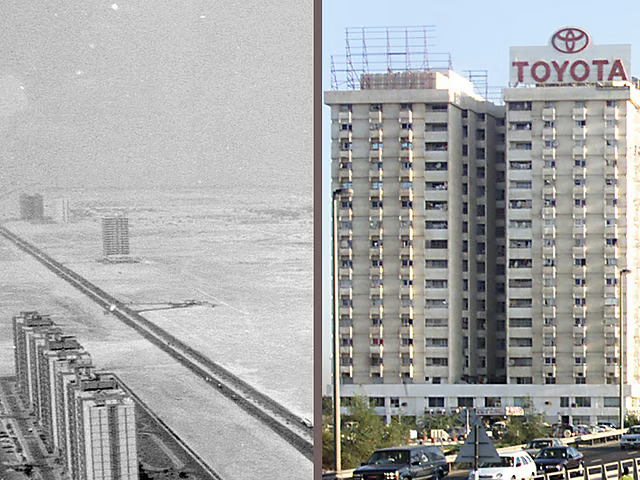 Investment
Sheikh Zayed Road redevelopment: what it means for investors
The Toyota Building's demolition signals a broader redevelopment wave on Sheikh Zayed Road. Here is what plot clearances along prime corridors mean for land values and off-plan launches.
By Roy El Baba Investment
Why Indian investors keep choosing Dubai real estate
Indian nationals are Dubai's largest foreign buyer group. Here's what drives that demand and how NRIs can buy freehold property step by step.
By Roy El Baba Investment
ELLE residences on Dubai Islands: what branded living costs you
ELLE's entry into Dubai real estate signals how fashion brands are reshaping the branded residence market. Here's what the premium actually buys you.
By Roy El Baba