

Is it too late to invest in Dubai property in 2026?
Buyers keep asking if Dubai's run is over. Eight market indicators from 2025 suggest the structural case for investing is stronger than ever.
The question every buyer is asking right now
Almost every serious buyer who walks into a conversation with us asks some version of the same thing: have we missed the Dubai real estate cycle? It is a fair question. Prices in prime communities have risen 40 to 70 percent since 2020 depending on the asset type, and off-plan launch queues in 2024 looked more like concert tickets than property sales. The instinct to hesitate is understandable.
The more useful response is not reassurance, it is data. Rather than making a directional call based on sentiment, this post lays out eight structural indicators that explain why institutional and private capital continues to flow into the Dubai property market heading into 2026, and what those figures actually mean for a buyer making a decision today.
Transaction volumes signal genuine end-user demand
Dubai recorded over 180,000 property transactions in 2024, according to Dubai Land Department figures, making it the highest annual volume in the emirate's history. That number matters because transaction volume is harder to manufacture than price. Developers can manage launch prices, but 180,000 individual DLD-registered deals reflect real buyers committing real capital.
The split between cash buyers and mortgage buyers has also shifted. Roughly 55 percent of transactions in 2024 were cash-funded, which points to a buyer base that is not leveraged to the point of fragility. When interest rates move, a cash-heavy market absorbs the shock far better than one dependent on cheap debt. For anyone learning how to buy property in Dubai, understanding this buyer composition is a useful starting point for gauging downside risk.
Price growth has been broad, not just concentrated in trophy assets
One concern about Dubai's 2021 to 2024 run was that gains were narrowly concentrated in ultra-prime communities like Palm Jumeirah and Downtown Dubai. The 2025 data tells a different story. Mid-market communities, including Jumeirah Village Circle, Dubai Hills Estate, and Dubai Creek Harbour, posted consistent year-on-year appreciation in the 8 to 14 percent range. Broad-based price growth is a sign of structural demand rather than speculative froth at the top of the market.
Rental yields have held up in parallel. Gross yields in Business Bay and Dubai Marina are still running at 6 to 7 percent annually for one-bedroom units, well above comparable assets in London, Singapore, or Hong Kong. When you factor in zero income tax on rental receipts, the net yield advantage widens further.
Off-plan activity and developer pipeline reflect long-term confidence
The Dubai off-plan projects segment accounted for approximately 60 percent of all 2024 transactions, a figure that reflects both buyer confidence in developer delivery and the attractiveness of payment plan structures. Developers including Emaar Properties, Sobha Realty, and Danube Properties launched projects totalling hundreds of thousands of units across the emirate, yet absorption rates remained high throughout the year.
A frequently asked question is whether this pipeline creates an oversupply risk. The counterargument is population growth. Dubai's population crossed 3.8 million in 2024 and the government's Urban Master Plan targets 5.8 million residents by 2040. At that pace of demographic expansion, a construction pipeline that looks large in isolation is less alarming when set against projected household formation numbers. Buyers considering off plan in Dubai should still stress-test the specific developer's track record and escrow arrangements, but the macro absorption case is credible.
Golden Visa and residency rules are a structural demand driver
Since the UAE expanded its long-term residency framework in 2022, the UAE Golden Visa through Dubai property has become a tangible purchasing incentive rather than a peripheral benefit. A property investment of AED 2 million or more qualifies for a 10-year renewable residency visa. In 2024, tens of thousands of property-linked Golden Visas were issued, according to ICP data.
This matters for market stability because it converts a portion of the buyer base from pure speculators into long-term residents with a personal stake in the community. Visa-linked buyers are less likely to exit at the first sign of a price correction. For buyers evaluating whether to cross the AED 2 million threshold, it is worth calculating whether the residency benefit justifies the price step-up, particularly in communities where that budget buys a meaningfully larger or better-located unit.
What the data means for a buyer deciding today
The honest answer to 'is it too late?' is that it depends entirely on what you are buying, at what price, and for what purpose. The eight indicators that support the Dubai property market structurally, sustained transaction volume, broad price growth, strong rental yields, population expansion, a diversified economic base, Golden Visa demand, post-pandemic infrastructure maturity, and government fiscal capacity, do not guarantee that every asset will appreciate. They do suggest that the market's structural foundations are more durable than those of a purely sentiment-driven cycle.
Overpaying for a poorly located unit in an oversupplied submarket remains a risk regardless of macro tailwinds. The discipline required is asset-level, not just market-level. A buyer who has read the macro case correctly but bought the wrong unit in the wrong building can still underperform. Use the structural data as a filter for the market, then apply rigorous unit-level analysis before committing. For a practical walkthrough of the purchase process, the Dubai properties for sale section and our buying guide are good starting points.
Frequently asked questions
Is the Dubai property market heading for a correction in 2026?
No major forecasting body is calling for a sharp correction. Population growth, low mortgage-to-cash buyer ratios, and government fiscal buffers reduce the likelihood of a hard landing. Localised oversupply in specific product types is a more realistic risk than a market-wide downturn.
What is the minimum investment to qualify for a Golden Visa through Dubai property?
A completed property purchase of AED 2 million or more qualifies for the 10-year UAE Golden Visa. The property must be fully paid or mortgaged with at least AED 2 million equity. Off-plan properties below handover do not qualify until title is transferred.
Are Dubai rental yields still competitive compared to other global cities?
Gross yields in Dubai typically range from 5 to 8 percent depending on community and unit type. London prime residential yields average 3 to 4 percent and Singapore averages 2.5 to 3.5 percent. Dubai's zero income tax on rental income widens the net yield gap further.
How do I assess whether an off-plan project is a sound investment?
Check the developer's delivery track record, confirm the project is registered with RERA and that the escrow account is active, review the payment plan structure, and benchmark the launch price per square foot against comparable completed stock in the same community. A unit priced above secondary market comparable values requires a strong location or product justification.
Which Dubai communities offer the best balance of yield and capital growth potential in 2026?
Mid-market communities with ongoing infrastructure investment tend to offer the strongest combined return profile. Areas like Dubai Hills Estate, Dubai Creek Harbour, and Business Bay have demonstrated consistent rental demand alongside capital appreciation. Your choice should also factor in your target tenant profile and the specific supply pipeline in each submarket.
More Investment posts
 Investment
Villa renovation vs buying new in Dubai: which pays off?
Some Dubai villa owners are spending up to $5.4m on renovations. We break down whether upgrading delivers better ROI than buying off-plan or resale.
By Roy El Baba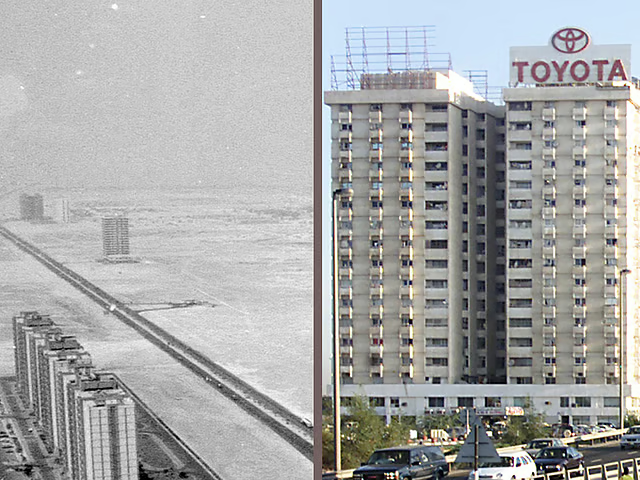 Investment
Sheikh Zayed Road redevelopment: what it means for investors
The Toyota Building's demolition signals a broader redevelopment wave on Sheikh Zayed Road. Here is what plot clearances along prime corridors mean for land values and off-plan launches.
By Roy El Baba Investment
Why Indian investors keep choosing Dubai real estate
Indian nationals are Dubai's largest foreign buyer group. Here's what drives that demand and how NRIs can buy freehold property step by step.
By Roy El Baba Investment
ELLE residences on Dubai Islands: what branded living costs you
ELLE's entry into Dubai real estate signals how fashion brands are reshaping the branded residence market. Here's what the premium actually buys you.
By Roy El Baba