

Why regional uncertainty is a buying signal for Dubai investors
Seasoned Dubai investors don't wait for calm. Here's how historical transaction data explains why geopolitical turbulence often creates the best entry points.

How Dubai investors read geopolitical noise
Every time regional tensions spike, a familiar pattern plays out in the Dubai property market. Sentiment-driven buyers hesitate. Transaction volumes dip briefly. And then, typically within one to two quarters, a wave of well-capitalised buyers moves in, absorbing available stock before prices reset higher. This is not speculation; it is a pattern visible in DLD transaction data across at least three distinct regional stress periods since 2008.
The instinct to treat uncertainty as a pause button is understandable but, for Dubai, historically expensive. Investors who sat out the 2014 to 2016 oil-price correction, the 2019 to 2020 regional slowdown, and the early months of the COVID-19 period all missed recoveries that, in some communities, delivered 30 to 50 percent capital appreciation within 24 months of the trough.
What the transaction data actually shows
Dubai's real estate sector recorded over 180,000 transactions in 2024, according to DLD figures, a volume that reflects structural demand rather than speculative noise. Quarterly dips tied to external events have consistently been shallower and shorter than those seen in comparable global cities. London, Singapore, and Hong Kong each took four to seven years to recover from their respective post-2008 corrections. Dubai's residential market recovered its 2008 peak by 2013, and again recovered sharply after the 2020 trough, with villa prices in communities like Dubai Hills Estate and Palm Jumeirah reaching new highs by 2022.
The underlying driver is structural. Dubai is not an oil-dependent residential market in the way it once was. Tourism receipts, financial services, logistics, and a growing tech sector now underpin demand. Average residential rents rose approximately 19 percent year-on-year in 2024, which compresses yields and supports asset prices regardless of what is happening across regional borders.
Where calculated buyers are looking right now
The communities attracting the most deliberate, research-led buyers during softness periods are typically those with strong rental fundamentals and limited future supply. Dubai Marina and Jumeirah Beach Residence (JBR) consistently maintain sub-6 percent vacancy rates, meaning buyers entering during a sentiment dip collect yield while they wait for the next capital appreciation cycle.
For buyers with longer horizons, Dubai Creek Harbour and Business Bay present a different thesis: infrastructure completion risk is largely behind them, and both communities are now in yield-generating territory rather than pure development-phase speculation. Off-plan buyers willing to look further out are active across off-plan projects in communities like Jumeirah Village Circle, where per-square-foot entry prices remain accessible relative to more established districts.
A less discussed angle: regional uncertainty tends to accelerate capital flight into Dubai from neighbouring markets, particularly Lebanon, Egypt, and more recently, parts of the Levant. This inbound flow has historically supported both transaction volumes and price floors during the very periods that cause hesitation among investors watching from Europe or Asia.
The mechanics of buying during a sentiment dip
Knowing that conditions may be favourable is one thing. Executing correctly is another. Buyers entering the Dubai property market during periods of lower competition need to move through due diligence faster than in a heated market, because motivated sellers and developers offering incentives do not stay patient indefinitely. Understanding how to buy property in Dubai, including transfer fees, DLD registration, trustee office processes, and NOC requirements, removes friction when speed matters. Our guide on how to buy property in Dubai covers the full process step by step.
Foreign nationals purchasing a property worth AED 2 million or more should also factor in the UAE Golden Visa through Dubai property, which provides a 10-year renewable residency. In an environment where buyers are seeking stability, that residency component adds a non-financial dimension to the investment case that is difficult to quantify but consistently cited as a deciding factor by buyers relocating from higher-risk jurisdictions.
Off-plan versus ready: which fits this window
The off-plan Dubai segment is where developers have most room to offer incentives during softer sentiment periods: extended payment plans, post-handover schedules, and fee waivers. Developers including Emaar Properties, Sobha Realty, and Danube Properties have all used previous soft windows to push inventory with enhanced terms. Buyers who lock in at those terms benefit from price appreciation during the construction period without deploying full capital upfront.
Ready properties carry a different risk profile. Buyers get immediate rental income and avoid construction risk, but they pay closer to market price and have less negotiating leverage than in a developer presale. The optimal choice depends on the investor's yield requirement, capital availability, and time horizon. For most international buyers entering now, a split strategy, part ready for yield and part off-plan for capital growth, tends to produce the most balanced outcome. Reviewing Dubai properties for sale across both categories gives a current view of what is available at each price point.
What this means for buyers sitting on the sidelines
The practical question is not whether regional uncertainty will persist. It will, periodically, as it always has. The question is whether the Dubai property market's structural demand drivers are strong enough to absorb that uncertainty and continue compounding. The evidence from the past 15 years suggests they are. Waiting for a clear horizon has, in every prior cycle, meant paying materially more for the same asset.
That does not mean every property or every price point is attractive right now. Service charges vary significantly across communities, and factoring them into net yield calculations is essential before committing. Our service charge calculator is a useful starting point for comparing the true cost of ownership across different buildings and districts. Due diligence does not slow down good decisions; it makes them defensible.
Frequently asked questions
Is the Dubai property market actually cooling down right now?
Transaction volumes and pricing data from 2024 do not support a broad characterisation of the market as cooling. Specific segments and communities show slower price growth, but overall DLD transaction volumes exceeded 180,000 in 2024. Selective softness is not the same as a market correction.
How does regional geopolitical tension typically affect Dubai real estate prices?
Historically, regional uncertainty has caused short-term sentiment dips in Dubai but has simultaneously driven capital inflows from neighbouring markets seeking stability. Net price impact has been neutral to positive within two to four quarters of any given regional stress event.
What is the minimum investment to qualify for the UAE Golden Visa through property?
A property purchase of AED 2 million or more qualifies the buyer for a 10-year renewable UAE Golden Visa. The property must be fully paid (not mortgaged above the qualifying threshold) and registered with the DLD.
Are off-plan properties a good option for investors entering during uncertain periods?
Off-plan can be advantageous during softer sentiment windows because developers tend to offer better payment terms and occasionally discounted entry prices. The trade-off is construction risk and a longer horizon to rental income. Buyers should verify developer track records and escrow arrangements before committing.
How do I start the process of buying property in Dubai as a foreign national?
Foreign nationals can own freehold property in designated zones across Dubai. The process involves selecting a property, signing a Memorandum of Understanding, paying a deposit, obtaining a No Objection Certificate from the developer if required, and completing transfer at a DLD-approved trustee office. Full details are in our buying guide.
More Investment posts
 Investment
Villa renovation vs buying new in Dubai: which pays off?
Some Dubai villa owners are spending up to $5.4m on renovations. We break down whether upgrading delivers better ROI than buying off-plan or resale.
By Roy El Baba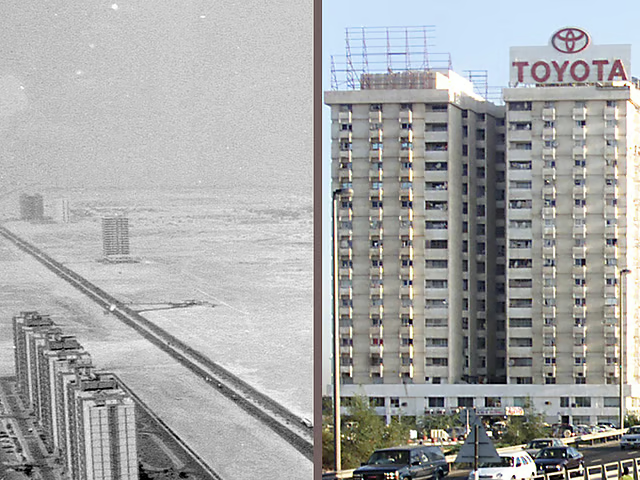 Investment
Sheikh Zayed Road redevelopment: what it means for investors
The Toyota Building's demolition signals a broader redevelopment wave on Sheikh Zayed Road. Here is what plot clearances along prime corridors mean for land values and off-plan launches.
By Roy El Baba Investment
Why Indian investors keep choosing Dubai real estate
Indian nationals are Dubai's largest foreign buyer group. Here's what drives that demand and how NRIs can buy freehold property step by step.
By Roy El Baba Investment
ELLE residences on Dubai Islands: what branded living costs you
ELLE's entry into Dubai real estate signals how fashion brands are reshaping the branded residence market. Here's what the premium actually buys you.
By Roy El Baba