

What robot-serviced apartments really cost Dubai buyers
A AED 700m Dubai development is putting eight robotic services on every floor. Here is what that means for service charges, valuations, and your exit.

What the Tréppan Vision project actually delivers
Tréppan Vision is a AED 700 million residential development scheduled for completion in Q4 2029. Its 463 units will be serviced by eight dedicated robotic systems deployed on every floor, alongside AI-enabled smart home technology integrated directly into the apartments. The pitch is that autonomous machines handle routine building tasks, from deliveries to cleaning support, reducing the load on human staff.
For context, this is not a one-unit experiment. Eight robot types across every floor of a 463-unit building represents a significant infrastructure commitment, and infrastructure costs money to install, insure, and maintain. Buyers who focus only on the novelty risk missing the financial implications embedded in that model. Those implications touch three specific areas: service charge structures, long-term maintenance budgets, and resale valuation.
Service charges: who pays for the robots?
In Dubai, service charges are set and collected under RERA's service charge index, which uses a rate per square foot applied annually. Standard residential buildings in areas such as Dubai Marina or Business Bay typically run between AED 12 and AED 22 per sq ft per year. Buildings with concierge robots, AI servers, sensor networks, and the specialist technicians required to service them sit in a different cost bracket entirely.
Robotic systems require scheduled hardware maintenance, software licensing, network infrastructure, and liability cover. Unlike a human cleaner whose costs are fairly predictable, a robotics fleet carries depreciation schedules, parts supply chains, and potential downtime costs. Developers often understate these numbers during the off-plan marketing phase. Buyers should ask for a projected service charge budget, not a marketing range, before signing. Use a service charge calculator to stress-test the numbers against your anticipated rental yield.
There is also the question of who bears the cost if a robotic system fails or becomes obsolete. Standard OA (owners' association) agreements push maintenance costs to the reserve fund, which is built from service charge contributions. If robotic technology turns over every five to seven years, as much of the current consumer robotics market does, the reserve fund requirements could be substantially higher than in a conventional building.
Valuation uplift: real or marketed?
Developers routinely argue that smart-home and amenity technology justifies a price premium. The honest answer is that this depends entirely on whether the market agrees at resale, not at launch. Dubai Hills Estate and Downtown Dubai both demonstrate that premium amenities can hold value when they are widely understood and consistently maintained. The key word is consistently.
AI and robotic features are genuinely novel in 2025. By 2029, when Tréppan Vision completes, several competing developments will likely have announced similar or more advanced systems. A valuation premium that exists at launch can compress sharply if the technology becomes standard across the market, or if the specific robotic fleet installed in 2029 looks dated by 2032. Investors planning a five to seven year hold should model for modest rather than generous technology premiums in their exit assumptions.
That said, there is a credible bull case. If robotic servicing genuinely reduces the need for on-site staff, the long-run service charge could be lower than in a comparable amenity-heavy building, which is a tangible financial benefit that buyers can quantify. The question is whether the developer's cost projections are conservative enough to trust. Interrogate the numbers before you commit.
Rental demand and tenant profile
Smart-home integration is increasingly a leasing differentiator for a specific tenant segment: tech-sector professionals, frequent business travellers, and younger high-income renters who already use automated home systems. In communities such as Dubai Internet City and Dubai Silicon Oasis, proximity to tech employers already drives a premium. A building that offers genuine AI-home integration could attract that same profile without the commute.
The risk is tenant concentration. A building that markets heavily to tech professionals can see vacancy spike during industry downturns. Landlords should consider whether the robotic amenity proposition appeals broadly enough to cover a wider tenant pool, or whether it is niche enough to create occupancy risk in a softer rental market.
Due diligence checklist for smart-building off-plan buys
Before buying into any AI-integrated development, run through a structured checklist. First, request the draft service charge budget from the developer, specifically line items for technology maintenance and the reserve fund contribution rate. Second, confirm whether the robotic systems are owned outright by the OA upon handover, or whether they are subject to a leasing or service contract with the developer or a third party. Third-party contracts that expire or reprice post-handover transfer cost risk directly to owners.
Third, review the escrow status of the project through the Dubai Land Department's approved developer registry to confirm funds are ringfenced. Fourth, ask for the specifications of the AI system: who built it, what is the support life commitment, and what happens if the technology provider ceases to operate. This is not hypothetical; several smart-home tech companies that were active in 2018 no longer exist. If you are new to the off-plan process, our guide on how to buy property in Dubai covers the full legal and financial framework.
Finally, speak to a RERA-licensed broker who can run comparable service charge data from similar premium buildings. The Dubai off-plan projects currently on the market offer a wide range of technology integration levels, and understanding where Tréppan Vision sits relative to peers is essential for pricing the risk correctly.
How tech-integrated builds fit a broader Dubai investment strategy
Smart-building developments are one segment of a market that continues to diversify by product type, geography, and buyer profile. Investors who want exposure to Dubai's technology narrative without the specific risks of a single high-tech project might consider spreading across a conventional premium unit and a smaller allocation to a smart-home development, treating the latter as a higher-risk, higher-upside position.
The UAE's broader infrastructure ambitions, including its National AI Strategy and the continued expansion of tech-sector employment, provide a macro tailwind for smart-home residential product. But tailwinds do not offset poor due diligence at the unit level. Whether you are considering a high-tech tower or a community villa in Arabian Ranches, the fundamentals of location quality, developer track record, and realistic cash flow modelling remain the primary filters. If you qualify, structuring your purchase through the UAE Golden Visa through Dubai property route adds a residency dimension that can further improve the investment case.
Frequently asked questions
Will robotic amenities increase service charges in Dubai buildings?
Almost certainly yes, at least initially. Robotics fleets carry maintenance, software, and insurance costs that standard buildings do not. Buyers should request an itemised projected service charge budget from the developer before purchasing, rather than relying on a broad per-square-foot estimate.
Can smart-home technology increase a Dubai apartment's resale value?
It can, but the premium is not guaranteed. Valuations depend on whether the technology remains relevant and well-maintained at the time of resale. If smart-building features become standard across Dubai's market by the mid-2030s, early-mover premium may compress significantly.
What should I ask a developer before buying an AI-integrated off-plan unit?
Ask for the draft service charge breakdown including technology maintenance line items, confirm whether robotic systems are OA-owned at handover or subject to third-party contracts, and verify the project's DLD escrow registration. Also ask for the support-life commitment on the AI platform itself.
Is a 2029 completion date a risk for this type of technology-heavy development?
Yes, in the sense that the technology landscape can shift substantially over four years. Systems that are cutting-edge in 2025 may be outdated by handover. Buyers should assess whether the developer has committed to a technology update pathway or whether the installed system is fixed at completion.
Are there examples of Dubai communities where premium amenities have held value well?
Communities with well-managed owners' associations and consistent infrastructure maintenance, such as Dubai Hills Estate and select towers in Dubai Marina, have generally held amenity premiums better than those with high service charges and inconsistent upkeep. Management quality matters as much as the amenity itself.
More Investment posts
 Investment
Villa renovation vs buying new in Dubai: which pays off?
Some Dubai villa owners are spending up to $5.4m on renovations. We break down whether upgrading delivers better ROI than buying off-plan or resale.
By Roy El Baba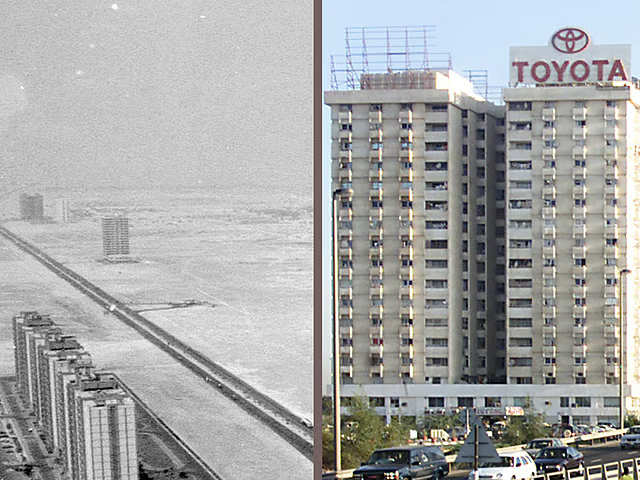 Investment
Sheikh Zayed Road redevelopment: what it means for investors
The Toyota Building's demolition signals a broader redevelopment wave on Sheikh Zayed Road. Here is what plot clearances along prime corridors mean for land values and off-plan launches.
By Roy El Baba Investment
Why Indian investors keep choosing Dubai real estate
Indian nationals are Dubai's largest foreign buyer group. Here's what drives that demand and how NRIs can buy freehold property step by step.
By Roy El Baba Investment
ELLE residences on Dubai Islands: what branded living costs you
ELLE's entry into Dubai real estate signals how fashion brands are reshaping the branded residence market. Here's what the premium actually buys you.
By Roy El Baba